
 EN (English)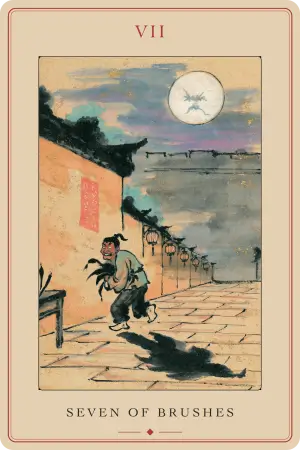


Minor Arcana ·
Eight of Brushes
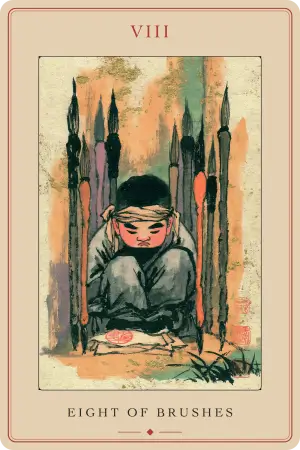
The self-built prison, drawn without a chain: a candidate fenced by his own writing brushes, before a cell door that has no lock.
Card at a glance
- Numerology
- 8
- Element
- Air
- Astrology
- Gemini, first decan · ruled by Jupiter
- Kabbalistic path
- Hod (Glory)
- Timing
- Late spring · Gemini season
- Yes / No
- Upright no · Reversed yes
Upright
self-imposed limits
anxiety
perfectionism
fear of judgment
paralysis
feeling trapped
negative thinking
powerlessness
Reversed
liberation
breakthrough
regained self-belief
release
courage
new perspective
willpower
the first stroke
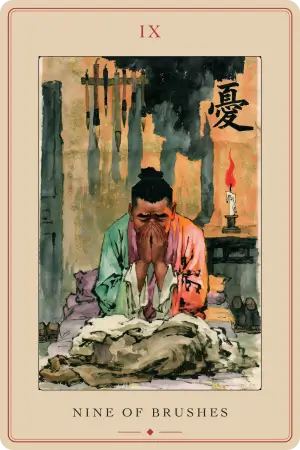
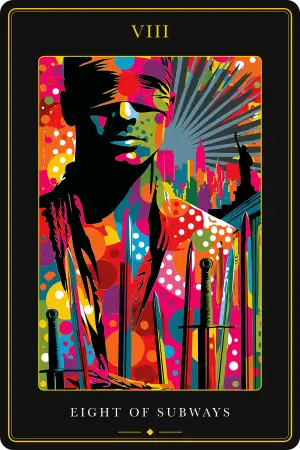
Eight of Brushes in each deck
Every deck reimagines the same archetype. Compare the art, then open a deck to read its full interpretation.
Imagery and symbolism
In the Tarot of Beijing the Eight of Swords becomes the Eight of Brushes, and the trap is redrawn as an imperial examination cell. A young candidate sits in a booth barely wider than his shoulders, knees drawn up, arms wrapped around them. Eight tall writing brushes stand upright around him like fence posts, closing him in on every side. The card is the deck's image of the self-built prison, and it carries not a single chain.
The brushes are the deck's suit of Air, the suit of mind, words, and trials. That the fence is made of brushes is the whole statement of the card: these walls are thoughts, judgments, and rehearsed failures. They are also tools. The same objects read as bars from inside the cell and as instruments in a working hand, and nothing about them changes except the candidate's relation to them.
A pale cloth is wound about the boy's brow, the deck's version of the Rider-Waite blindfold. It does not fully cover his eyes. He has lowered them himself, so his blindness is fear of failure rather than lack of light. His scowling, downturned face shows a will turned inward against itself.
Under his feet lie sheets of paper stamped with a red seal, the examination papers and the verdict he dreads. He sits on them without looking. The judgment he fears is already beneath him and has not crushed him. At the edge of the scene the cell door is drawn only faintly, and it has no lock. This is the deck's translation of the loose bindings on the Rider-Waite woman: escape asks for no miracle, only the decision to test the door.
Washes of orange and teal press close around the figure, giving the whole card the width of one seated body. The narrowness is atmospheric, felt rather than built. A small red seal sits in the corner, as on every card of the deck, a quiet reminder that someone made this image the way someone made this prison, and what is made can be unmade.
Core meaning
The Eight of Brushes is Beijing's card of psychological confinement, and it states its argument through the detail everyone overlooks: the brushes are not driven into the candidate, they stand beside him, and they are his own tools mistaken for a fence. The restriction is real to the person inside it and mostly written in his own hand. This prison is built of thought, and it comes apart when perception and mindset change.
Where the canonical Eight of Swords shows a bound and blindfolded woman among swords stuck in the earth, this deck keeps the meaning and moves the scene into a world of ink and examination. The candidate is confined by fear, perfectionism, and the dread of being judged. He has prepared endlessly and still cannot bring himself to write the first character, because he expects a flawless page and therefore produces none. The card names the cause plainly and then points, just as plainly, at the unlocked door.
Upright meaning
Upright, the card describes an active, ongoing stasis. You feel trapped or restricted, powerless before obstacles that seem to block every path, and the fence is mostly made of your own instruments stood on end. Notice where you feel walled in right now, whether it is a task you keep preparing for and never starting or a conversation you keep rehearsing and never having. Then test the door before declaring yourself trapped, and write one honest line rather than rereading the anxious ones. Be gentler with yourself than the examiner in your head would ever be.
In love. The relationship has narrowed to the width of an examination cell, and you sit inside it rehearsing what to say and never saying it. It can mark a temporary separation caused by outside circumstances, or an inability to express feeling because you fear your words will be graded and struck through. Reread the situation as a letter from the other person rather than as your own examination paper, and remember that the cell door has no lock.
In career. Professional stagnation, or difficulty carrying out your duties. The cubicle has become an examination cell and the deadlines a row of brushes standing like fence posts. The overload may be genuine, or it may be the conviction that every piece of work will be graded and found wanting. Look at the situation honestly, respect your own boundaries, and preserve the ink for the pages that actually matter.
In finances. Limitation and blockage in money matters. Resources seem withheld, like an allowance kept back until the examination is passed, and delayed payments or debts can feed a sense of despair. Many of these limits are entries in your own ledger of fears. Strengthen self-discipline, seek new paths, and recall the card's quiet detail: the door of the cell has no lock.
In health. Your body asks for care while fear keeps you hunched, knees to your chest, in a cell of habits barely wider than your shoulders. There may be confusion about your physical state and a sense that improvement is needed with no clear way to reach it, sometimes with suppressed emotion writing itself onto the body. Reflect on your condition without self-punishment, and prepare gently for change.
Reversed meaning
Reversed, the blindfold of fear slips and the candidate sees that the compound gate was open the whole time. He lifts the cloth from his brow, stands, and finds the cell door swinging open at a touch. The fears that felt like walls turn out to be a row of writing brushes, and the brushes return to his hand as instruments. This is the awakening the card has been pointing to: you recognize the limits as self-made, name them one by one like characters on a page, and begin to work through them.
In love. After a long period of emotional stagnation you overcome the block and gain freedom. The rehearsed words are finally spoken aloud, and they land more gently than the examiner in your head predicted. Complicated situations resolve, new understanding emerges, and the bond moves to a fresh stage. Keep walking down the lane even where the lanterns have not yet been lit.
In career. A conscious release from limitation and a re-evaluation of old beliefs. The fear of the red verdict-seal loses its power, and self-confidence grows alongside the drive to advance. Openings appear on the job market that seemed to sit behind a locked door, and the door was never locked. Old methods give way and inner barriers weaken.
In finances. Relief from financial pressure. You may see release from old debts, a change of work that raises your income, or the sobering realization that uncontrolled spending has to stop. Circumstances improve, though effort is still needed. Leaving the cell does not by itself fill the purse, so set realistic goals the way a copyist sets a daily quota of characters rather than demanding one perfect page.
In health. Self-imposed physical limits resolve. You let go of punishing regimens and rules copied from someone else's copybook, return to steady movement, or replace a complicated regime with something simple you will actually keep. After a stretch of indecision you find a workable path to physical balance, undertaken with patience rather than dread of the grade.
Historical notes
The card the Beijing deck reworks is the Eight of Swords, and its shape was set long before any scene was painted on it. In the Tarot de Marseille the pip was non-scenic, eight blades interlocked in a tight geometric pattern that already suggested compression and a closing net. Early cartomancers such as Etteilla assigned it obstacles and situations to navigate, and hinted at hope and support in reverse. The occultist Papus described it as an enemy whose victory is only partial, which leaves the subject a window for escape.
The Hermetic Order of the Golden Dawn titled it the Lord of Shortened Force and read it as intellectual energy misspent on petty detail, force wasted while the larger picture goes unaddressed. In 1909 Pamela Colman Smith, working under Arthur Edward Waite, gave the card its most familiar face: a woman bound and blindfolded inside a cage of eight swords, a castle on the cliff behind her. Waite called the state temporary durance rather than irretrievable bondage, and Smith drew the ropes loose enough to shrug off, so the escape was written into the picture from the start.
The Tarot of Beijing carries that reading into its own world. It keeps the temporary, self-made confinement and translates the loose ropes into a cell door without a lock, the swords into upright brushes, and the blindfold into a worry-cloth the candidate has lowered over his own eyes. The verdict Waite left implied becomes a red-sealed examination paper the boy is already sitting on.
Correspondences
Number. Eight, and in China a number of luck and prosperity, which makes its appearance here deliberately ironic. Eight is the endless knot and the balanced cycle, and in its bright aspect it signals mastery and achievement. Traced without lifting the brush, the same figure closes on itself, and in its shadow it means control turned to suppression and structure turned to stagnation. The eight brushes stand in perfect order around the candidate, so order itself has become his fence.
Astrology. The first decan of Gemini, roughly May 21 to 31. Gemini is movement, mental activity, and constant exchange, the temperament of this suit, and the first decan brings force to the life of the mind. In the shadow the card shows, that same force turns inward and builds the examination cell.
Element. Air, the element of the suit of Brushes, of mind, words, and trials. When thought meets an obstacle it circles into internal dialogue and endless reassessment. The Eight of Brushes shows what happens when the circling never resolves into a first stroke, brushes standing on end instead of moving across paper.
Ruling planet. Jupiter, planet of growth and philosophy, ruler of this decan. Here Jupiter promises new opportunity after deep re-evaluation, the open door drawn faintly at the edge of the card, while warning against the inflated expectation that curdles into paralysis: the candidate who demanded a perfect essay and so cannot write a single line.
Sphere. Hod, Glory, the eighth sphere on the Tree of Life and the seat of structured mind, where all the Eights sit. When the free-moving Air of Swords enters the rigid order of Hod, thought hits its own walls and bounces back into a narrow mental cell.
Psychological perspective
The person of this card lives as if seated in an examination cell of their own construction. Often capable and highly trained, they feel stuck and unable to move because of psychological obstacles rather than real ones. They are the eternal candidates, the ones who have prepared endlessly and still cannot bring themselves to write the first character. Their state swings between exhaustion and brief clarity, yet the sense of being walled in persists.
This is the anxiety of the day rather than the terror of the night. The mind knows, somewhere underneath, that the panic has no immediate physical cause, and it cannot stop the loop. Perfectionism paralyzes them before the possibility of a blot on the page. They see examiners where there are none and read every task as a verdict, which is how the card so often marks imposter syndrome: the restriction is cognitive long before it becomes material, and the person tells themselves they cannot while quietly longing to try. The way out is the therapist's route as much as the tarot reader's, naming the belief, testing whether the threat is real, and taking one small action the fear would forbid.
Eight of Brushes across decks
Rider-Waite-Smith. The canonical card shows a woman bound and blindfolded inside a cage of eight swords, a castle on the cliff behind her, her ropes drawn loose enough to escape. Beijing keeps the temporary, self-made confinement and re-costumes it as an examination cell, trading the sword-cage for eight upright brushes and the loose ropes for a door with no lock.
Tarot de Marseille. The classic pip is non-scenic, eight blades interlocked in a tight geometric weave that suggests compression rather than a narrative scene. Beijing supplies the narrative the Marseille card withholds, giving the compression a face, a booth, and a dropped worry-cloth.
Crowley-Thoth. Crowley discarded the bound woman and named the card Interference, a clash of mismatched blades standing for cognitive dissonance and a will thwarted by its own second-guessing. The Beijing candidate lives that interference from the inside, unable to commit a first stroke because the mind digs a counter-argument for every argument.
Modern reframings. Recent decks push the psychology further. Kim Krans's Wild Unknown binds a butterfly in webbing beneath leaning swords, and Lisa Sterle's Modern Witch rests a helping hand on the captive's shoulder to show the support she is too blindfolded to see. The Tarot of Beijing belongs to that movement, keeping the escape visible and adding the reminder that the fence is a row of the candidate's own instruments.
In combination and context
The Eight of Brushes colors a spread with restriction and inward pressure, and its neighbors show whether the walls are hardening or coming down. Beside cards of upheaval it acts as a reality check, marking a querent who clings to a false foundation out of fear while change arrives anyway. Beside cards of material hardship it underscores how mental entrapment worsens a thin season, the anxious mind making a narrow situation narrower.
Watch the cards that soften it. A neighbor of help, recovery, or a reaching hand reads as the loosening of the bindings, the moment support becomes visible and the candidate starts to stand. In love spreads the surrounding cards tell you whether the silence is a pause for reflection or a wall: a card of rehearsed inaction keeps the candidate seated, while a card of movement invites the first honest line.
When the Eight of Brushes keeps returning to your readings, treat it less as an outside verdict pressing on you and more as a standing question. Is the fence real, or is it a row of your own tools stood on end? The answer is usually found by testing the door.
Questions for reflection
- Where do you feel walled in right now, and how much of that fence is built from your own instruments rather than anyone else's?
- What would you write if you knew the page could not be graded, and what does that tell you about the examiner in your head?
- What single action, forbidden by your fear, would turn one of your brushes back from a fence post into a tool?
The general meaning follows the Rider-Waite-Smith reading — the reference used across Tarot Academy. Open a specific deck above for its own interpretation.
Frequently asked questions
Explore the Tarot
Latest Posts
Discover the ancient wisdom of tarot cards and unlock the mysteries of your spiritual journey. Our blog is your gateway to understanding the rich symbolism, meanings, and practical applications of tarot reading.




















































