
 UZ (Ўзбек)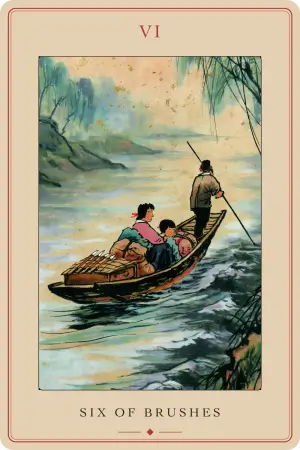


Minor Arcana ·
Seven of Brushes
A candidate slips out of the sleeping examination compound with an armful of borrowed brushes, and the moon takes notes.
Karta haqida qisqacha
- Numerology
- Seven
- Unsur
- Air
- Astrologiya
- Moon in Aquarius III (Feb 9–18)
- Kabbala yo'li
- Netzach (Victory)
- Vaqt
- Winter · slow, over months
- Ha / Yo'q
- Upright no · Reversed exposure
Upright
secrecy
cunning
strategy
the indirect path
borrowed brilliance
discretion
wise caution
watching others
Reversed
exposure
guilt
self-deception
betrayal revealed
failed scheme
confession
shame
conscience
Har bir to'plamda Seven of Brushes
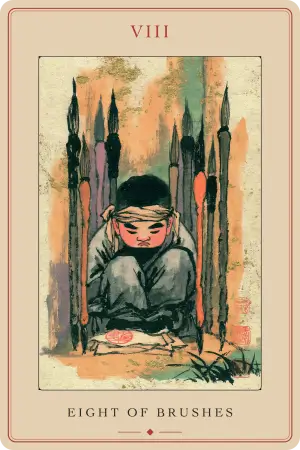
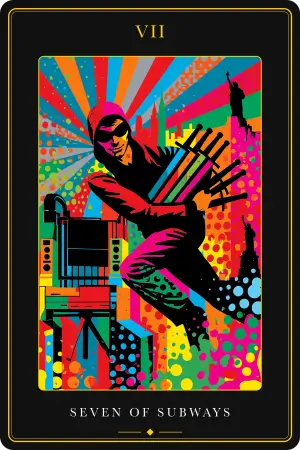
Every deck reimagines the same archetype. Compare the art, then open a deck to read its full interpretation.
Imagery and symbolism
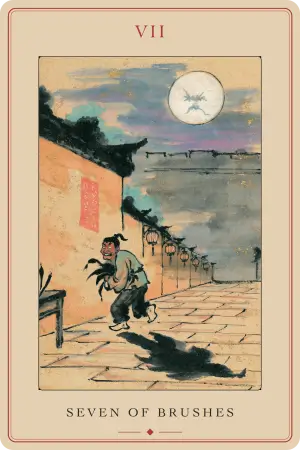
In the Tarot of Beijing the Seven of Swords is the Seven of Brushes, and it moves the whole scene indoors, into the imperial examination compound at night. A candidate steals away between the rows of sealed cells, arms full of brushes that are not his. His essay will be brilliant, and every line of it will belong to someone else. The deck takes the suit of the mind and shows talent turned sideways into trickery: the skill to reach a goal by any quiet means, honest or not.
He presses five brushes to his chest, the way the Rider-Waite thief clutches five swords by their blades. Five is the count of nerve here, the bravery and decisiveness of a man who has staked one night on a single maneuver. Two brushes stay behind in their pot on the writing stand. They are the part of the work that cannot be borrowed and the trace that will give him away, and they read as the plan left incomplete. Split five and two, the brushes become a small lesson in priorities: he could analyze and choose, but he could not take everything without being seen.
The palette is ink and one accent of red. A vermilion notice is pasted on the compound wall, the posted examination list, standing in for the public judgment that waits at the end of every hidden act. In this city the results are always posted eventually. A row of dark lanterns lines the wall, the watchers who happen tonight to be asleep. His face is flushed and his eyes cut back over his shoulder, and his ink-black shadow spills across the paving stones ahead of him, larger and darker than the man, the deed already running out in front of him.
Above the roofline hangs a full moon, and inside its disc a faint figure watches. No one shouts in this card and no guard gives chase. The sky simply keeps a record. The moon files a report, and the report is his own conscience.
Core meaning
The Seven of Brushes is about tactics over force, the side gate over the front hall. Where the honest queue means brute effort and open confrontation, this card takes the indirect route: strategy, diplomacy, discretion, and the quiet use of what belongs to others. It is the sharp mind that learns faster by watching than by asking, and the willingness to act inconspicuously to get where it wants to go.
Beijing keeps the archetype's core question and sharpens it. The classic Seven of Swords asks who is deceiving whom, and for what purpose. This deck answers with a specific image and a specific cost. The candidate can carry borrowed brilliance out into the dark, but he cannot carry it past the examiner who compares the strokes, and he cannot carry it past the moon. So the card holds two truths at once. Sometimes discretion is simply wisdom, the letter carried at night, the plan kept private until it is ready. Sometimes it is theft dressed as cleverness. The work of the card is to know which one you are practicing, because in the hutong even an empty lane has a witness.
Upright meaning
Upright, the Seven of Brushes points to a moment that rewards ingenuity, planning, and the indirect path. Study the situation more deeply, because a side gate may exist where you assumed a wall. Watch others' words and moves closely, keep your own counsel, and prepare each step in advance rather than charging the front hall. The one caution written in the margin is to count what you are carrying: how many of these brushes are truly yours?
In love. Hidden feelings, a concealed courtship, or a bond in which one person shows far less than they keep. It can mean delicacy used to avoid open conflict, the meeting no one on the lane is told about. It can also mean guardedness that has curdled into secrecy. Make sure both partners are writing in their own hand and reading the same page, and where something feels inconsistent, ask gently until the ink dries clear.
In career. Strategic, solitary work that loves the night shift and the closed door. You face an inventive project or a complex task that wants unusual angles, careful preparation, and quiet research before the first stroke. Rely on your own skill, think the plan through, and use unconventional methods where the conventional route is blocked. Build the essay from your own lines, because borrowed brilliance passes the first reading and fails the second.
In finances. Income earned by creative, indirect means, or a personal project worked on quietly until it is ready to show. The card favors subtlety and maneuvering, but it warns you to check whose brushes you are counting into the profit. A gain built on someone else's work gets re-weighed later on a scale you do not control. Be cautious with proposals and anything signed by lantern light.
In health. A quiet, strategic campaign rather than a punishing one. Small consistent moves practiced privately, an individual regimen no one else on the lane follows, exercises learned alone. Do not be afraid to experiment and find your own path to feeling well. The one honest note is to copy no one's routine wholesale. A regimen written for another body, like a borrowed essay, will not survive the examination.
Reversed meaning
Reversed, the borrowed hand is recognized as borrowed. What was written in another's stroke is compared with the original and gives itself away. Hidden motives and quiet maneuvers come to light, and taking a risk now leads to loss or disgrace rather than advantage. Secrets surface, schemes are uncovered, plans fall apart. The other face of the reversal is self-deception: circling a truth so long that you have convinced yourself the borrowed lines were always your own.
The advice is a dawn confession over a noon verdict. Expose the falsehood and restore the truth even when it costs, because a confession offered early costs far less than an exposure forced on you when the lists go up.
In love. The hidden letter is found and the borrowed words are named as borrowed. You face the hard fact that you were deceived, or that you were the one writing in someone else's hand. Everything concealed becomes visible, and the deceit, once out, forces a reckoning. Painful as it is, this can also be release from a long pretense. Love, like calligraphy, is judged by the honesty of the hand.
In career. Evasion and a missing plan. It can show work quietly passed off as one's own, delayed decisions, or capacity overestimated until the schedule slips and colleagues sense something is off. What was copied will be recognized. If the task is genuinely beyond you alone, say so, because asking a colleague for help costs far less than borrowing their work in the dark.
In finances. Dishonest dealings and loss through deception or theft. Unreliable people may try to trick you, or shortcuts you took yourself now come home, and money gained by a borrowed hand slips away just as quietly. Read every line twice, verify all information, and act cleanly. Quickly gathered coins scatter quickly.
In health. A gap between the promised result and the real one, often because the plan was copied from another body rather than written for yours. It can also point to quiet neglect: skipped practice hidden even from yourself, a reluctance to read honestly what sleep, energy, and breath are reporting. Abandon the borrowed dogma and draft a regimen in your own hand.
Historical notes
The Seven of Swords began as a non-scenic pip. In the Tarot de Marseille it is a single upright sword crossed by six others with flowers at the intersections, read by esoteric commentators as a futile love and, more usefully, as the paralysis of analysis: the thinker who plots every outcome and, from sheer overthinking, never picks up the sword at all.
The familiar thief arrived in 1909, when Pamela Colman Smith drew the Rider-Waite-Smith card under Arthur Edward Waite's direction. Her figure creeps from a military camp in a polka-dot tunic and fez, five swords grasped by the blades, two left planted behind him, three small figures in the background oblivious to the theft. His body moves one way while his head looks back the other, an action caught at its most unstable. Waite's own 1910 text is stranger than the picture: alongside "design, attempt, wish" and "a plan that may fail" he adds an out-of-place positive, "a good card; it promises a country life," a relic of older fortune-telling that almost no reader uses today.
The Golden Dawn had named the card the Lord of Unstable Effort, and Aleister Crowley retitled it "Futility" in the Thoth Tarot, stripping the human scene for a single solar sword battered by six smaller planetary blades: one good intention eroded by a restless, overactive mind. The Tarot of Beijing keeps the theft that Smith made central and gives it a stage of its own. It moves the camp to the examination compound, swaps swords for brushes, and adds the one thing the older cards only implied, a witness overhead that never sleeps.
Correspondences
Number. Seven, the number of reflection, introspection, and assessment. In the suit of the mind it turns restless, a "yes-but" cast of thought where feelings of isolation grow prominent. Beijing reads seven as the third watch of the night, the hour when the compound sleeps and only the candidate and the moon are awake, and it asks you to turn inward and examine which of the brushes in your arms are genuinely your own.
Astrology. The Moon in the third decan of Aquarius, roughly February 9 to 18. Aquarius favors original, non-standard methods, the side gate over the front hall, cool logic bent toward invention. The Moon veils the truth and blurs certainty, which is why individuals under it can delude themselves as easily as they mislead others. In this deck the Moon is also literal: the witness hanging over the compound wall, softening the scheme with intuition while recording it all the same.
Element. Air, the realm of thought, words, and communication, everything written and everything left unwritten. Here Air is strategy and evaluation, the careful weighing of a situation before a single stroke is made, and the unrestrained drive toward a goal that sometimes takes improper paths.
Kabbalah. Netzach, the seventh sphere on the Tree of Life, Victory and desire, joined to Swords as the formative world of Air. The pairing is volatile: the emotional pull of Netzach disrupts the cold logic of the suit, which is the "divided mind" behind the Golden Dawn's Unstable Effort.
Elemental dignity. As an Air card it strengthens other Air cards and the intellect around it, and its scheming sharpens beside cards of hidden knowledge. Set against grounded Earth or open Fire, its maneuvering can read as either shrewd or evasive, depending on the company it keeps.
Psychological perspective
The person of this arcana is the cleverest candidate in the compound, the one who found the unlocked gate. They take risks for their goals, seize opportunities fast, and learn more by watching than by asking. They keep secrets well and manage their anxiety in silence, preferring to work alone and at night, several moves prepared in advance. Under the apparent coldness there is real feeling. They know exactly which strokes are theirs and which are borrowed, and the difference costs them more than they let show.
The modern reading of the Seven of Swords lives here too. It is the card of imposter syndrome, the competent person who feels like a fraud about to be unmasked, stealing from their own potential by playing small. It is the mirror for self-deception that asks where you are sneaking around your own truth, what mask you wear only to feel safe. And it holds a genuine strength: when a system is rigged and brute force is foolish, cunning, discretion, and the quiet exit are acts of survival rather than simple dishonesty. The whole difficulty of the type is that the same talent serves both the escape and the lie.
Seven of Brushes across decks
Rider-Waite-Smith. The thief creeps from a military camp with five swords held by the blades and two left planted behind him, head turned back over his shoulder. Beijing keeps the exact count and the backward glance but moves the theft into the examination compound and puts brushes in his arms, so the stolen thing is an essay rather than a weapon.
Tarot de Marseille. A single central sword crossed by six others, no human figure, read as the paralysis of analysis. Beijing restores the scene the Marseille pip withholds and turns geometry into a person mid-maneuver.
Crowley-Thoth. Crowley's "Futility" shows a solar sword chipped by six planetary blades, one intention worn down by an overactive mind. The Beijing card answers the same futility with a plot that works right up until the strokes are compared.
Modern reframings. Recent decks soften or reroute the theft. The Wild Unknown shows a fox asleep on a sword with one eye open, shifting the card from stealing to guarded self-interest, while other decks read it as imposter syndrome or the lone strategist. The Tarot of Beijing belongs to that reframing, keeping the theft but hanging a conscience over it in the shape of a watching moon.
In combination and context
The Seven of Brushes colors a spread with maneuver and hidden motive, and its neighbors decide whether the maneuver is wisdom or deceit. Beside cards of intuition it confirms that a gut feeling about a hidden agenda is correct and should be trusted over the tidy explanations offered by others. Beside cards of collapse it turns explosive, the concealed flaw that triggers an unavoidable fall, since both the Seven of Swords and the Tower answer to Uranus.
Paired with the Moon it doubles into delusion and self-sabotage, a situation so clouded by feeling that no fact can be trusted. Read against its own suit, the Five of Swords is the frontal attack and the Seven the night ambush, cunning where the Five uses force. The Page of the suit gathers information openly, while the Seven hides what it knows and looks over its shoulder.
In position, an upright Seven of Brushes near the outcome favors the discreet, indirect route, the quiet job search or the plan kept private until it is ready. Reversed, or crossed by cards of judgment like the vermilion notice on the compound wall, it warns that the borrowed brilliance is about to be posted for the whole lane to read. When it keeps returning, treat it as the stalker card it often is, less an outside betrayal than a question turned inward: whose lines are you writing, and are you circling a truth instead of facing it?
Fikr yuritish uchun savollar
- Whose lines are you writing right now, and are you presenting borrowed work, an idea or a credit or an effort, as your own?
- Where are you being discreet because it is genuinely wise, and where are you being discreet because the truth would cost you?
- If the moon over the compound filed a report on today, would you be able to meet your own eyes reading it in the morning?
The general meaning follows the Rider-Waite-Smith reading — the reference used across Tarot Academy. Open a specific deck above for its own interpretation.
Frequently asked questions
Tarotni kashf eting
So'nggi maqolalar
Taro kartalarining qadimiy donishmandligini kashf eting va ma'naviy yo'lingizdagi sirlarni oching. Blogimiz taro o'qishning boy ramziyligi, ma'nolari va amaliy qo'llanilishini tushunishga eltuvchi darvozadir.




















































