
 UZ (Ўзбек)


Major Arcana · 20
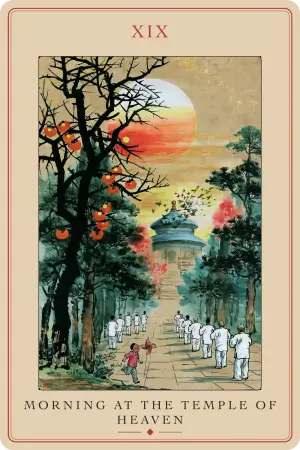
Morning at the Temple of Heaven
Unhidden happiness at sunrise: a Beijing park where nobody is doing anything important, and that is the harvest.
Karta haqida qisqacha
- Numerology
- XIX
- Unsur
- Fire
- Astrologiya
- Sun · Leo
- Kabbala yo'li
- Resh (Hod → Yesod)
- Vaqt
- Sunrise · summer · every morning
- Ha / Yo'q
- Yes
Upright
joy
vitality
clarity
openness
health
ripeness
play
belonging
Reversed
blocked joy
burnout
false cheer
dimmed energy
delay
lost play
isolation
toxic positivity
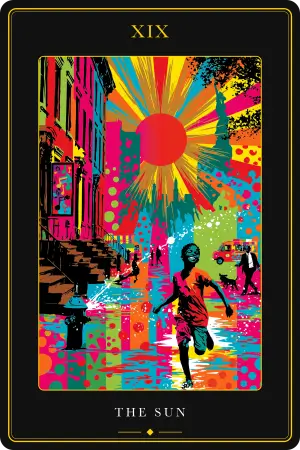
Har bir to'plamda Morning at the Temple of Heaven
Every deck reimagines the same archetype. Compare the art, then open a deck to read its full interpretation.
Imagery and symbolism
In the Tarot of Beijing the Sun is called Morning at the Temple of Heaven (天坛之晨), and it hides every traditional meaning of the card inside an ordinary morning. Where the Rider-Waite card gives a radiant face, a naked child, and a white horse, this deck gives a sunrise over a Beijing park. The rising sun over the Hall of Prayer for Good Harvests is painted huge and low, vermilion melting into gold, and it has no face. In this deck the cosmic always shows through the small and human, so the radiance is not on the sun but on the people. Gold flecks in the kraft paper catch around it like scattered light.
The setting carries the card's deepest meaning and its deepest joke. The Temple of Heaven was the ground where emperors performed the most important ritual of the empire, praying to Heaven for the harvest. That same ground is now a public park where elders do tai chi and a boy chases pigeons. Heaven's answer to the emperors' prayer turned out to be this: ordinary people, healthy and unhurried, on a warm morning. Nobody here is doing anything important. That is the happiness, and that is the harvest.
The rows of elders in white stand in for the RWS child's purity and the white horse's nobility. Their white clothing, slow synchronized movement, and breath in the cold air make vitality a discipline of gentleness. The boy running with a pinwheel through their slow ranks is the inner child of the traditional card, set loose; his pinwheel quietly echoes the Wheel of Fortune from card X, fortune's wheel now spun for pure delight, and the red of his jacket is the deck's vermilion accent for life force. The persimmons, ripe and orange, hang like small suns on a bare winter tree and replace the four sunflowers; in China the persimmon (柿) is a homophone of 'affairs' (事), so painted persimmons wish that all one's affairs go well. A burst of pigeons crosses the blue triple-eaved roof, the same flock with bamboo whistles the Newcomer heard on card 0, a laughing warning there and pure jubilation here. A small red seal sits in the corner, the artist's quiet drop of the same sunrise.
Core meaning
Morning at the Temple of Heaven is Beijing's Sun, and its statement is almost embarrassingly plain: nobody here is doing anything important, and that is the happiness. Where Western images of the Sun speak of triumph, the crowned hero and blazing truth, this card makes a quieter and more radical claim. The highest state available to a person looks like an unremarkable morning, fully inhabited. Joy is not the reward for solving life. It is the natural temperature of life once you stop demanding that every hour justify itself.
The card is open, unhidden happiness. Its situation is a park at sunrise where everything is visible and nothing is locked, and in a spread it says the conditions around you are transparent: no intrigue behind a curtain, no small print. Effort made earlier is ripening now the way persimmons ripen on a bare tree, in its own season, without your pushing. Success here does not arrive as triumph over anyone. It arrives as well-being: health, ease, warmth between people, the settled certainty of elders who come to the same park every dawn and are glad every time. And it carries the boy with the pinwheel, so whatever you are doing has room in it for play, and the play runs straight through the middle of the serious business rather than beside it.
Upright meaning
Upright, the card promises clarity, vitality, and joy taken in the open. Come out into daylight. Say plainly what you want, show your work where people can see it, and let them watch you enjoy it. This is the time for early starts and honest conversations without a curtain, for trusting that the simple, visible path works. Keep your routine as the tai chi elders keep theirs, unhurried and daily and done for its own sake, and leave room for the pinwheel, the small unserious thing that delights you. Joy taken now is not stolen from the future; it is the point.
In love. Daylight love: the relationship you hide from no one, least of all yourself. Feelings match words, plans are made in the open, and both people grow healthier and easier to be around. This is the love of shared mornings rather than dramatic nights, and for long unions it shows the persimmon stage, sweetness ripened over years and brightest now. A fine omen for making a bond public, meeting families, or marrying.
In career. Work that leaves you healthier. It indicates goals reached, recognition given in the open, and above all a daily rhythm that suits you, a practice you would keep even unpaid. Show your results publicly, take a visible role, and start the new project early in the day and early in its season. The counsel is the elders': steadiness over heroics, excellence accumulated one unforced day at a time.
In finances. Ripened prosperity. Income arrives the way persimmons do, from trees planted earlier, in season, in plain sight. Expect fair returns on honest work, clean contracts, open books, money you could describe to your grandmother at the park without lowering your voice. An excellent omen for recovery after a hard stretch. Its one instruction is to enjoy some of it now, because wealth on this card exists to buy warm, ordinary, sunlit life.
In health. The deck's healthiest card, and its prescription is drawn right on it: early light, fresh air, gentle daily movement, company, and food in season. It favors morning practices above all, tai chi, qigong, yoga, walking, disciplines sustainable for decades because they are unforced. Beauty here is radiance rather than construction. For recovery questions it is a bright omen: the body's own morning is coming, so meet it outdoors.
Reversed meaning
Reversed, Morning at the Temple of Heaven is the same park under an overcast sky, or worse, the same park with you standing in it unable to feel it. The sun has risen, the persimmons are ripe, the elders move through their forms, and something in you stays cold. The card indicates joy that is available but not received: success that looks right on paper and tastes of nothing, comfort without warmth, a holiday attended like a duty. It can mean genuine external obstacles, a delay or a season of grey mornings, but its center of gravity is inner: lost playfulness, dimmed energy, an inability to be simply and publicly glad. Sometimes it warns of false sunshine, cheerfulness performed for others while the inner park stands empty. The remedy is the elders' remedy: do not force the smile, go back to the routine, because they do not wait to feel inspired before they come to the park. They come, and the feeling follows the practice.
In love. A relationship standing in its own park and not feeling the sun. Outwardly things may look right, but the warmth has thinned: affection performed rather than rising, joy postponed until after the next busy stretch that never ends. Return to the small daily forms of tenderness before the grand summit talks, bring one playful thing back into the routine, and say the warm words in daylight instead of saving them.
In career. Work that has gone grey while staying formally fine. The tasks get done and every morning costs more than it returns. It can indicate joyless overwork, recognition delayed or given without warmth, or a role where the playful part of you has been quietly banned from the park. Fix the mornings first, then ask one question the reversed Sun cannot argue with: does this work leave any warmth in me by evening?
In finances. Prosperity that gives no warmth, or warmth delayed by real clouds. It can mean results below expectation and a postponed payment, usually a delay rather than a ruin. More often it shows money trouble of the inner kind: anxiety that persists after the accounts are fine, the discovery that the number you worked years for does not by itself produce a single good morning. Reassess in plain light and put a portion where it buys actual mornings.
In health. Dimmed vitality: fatigue that sleep does not clear, low mood tied to low light and low movement, a body kept indoors and important. It points to sun-and-rhythm deficits in the literal sense, too little daylight and meals off-season, and it can flag burnout expressing itself physically. Repair the morning first, rebuild play before performance, and if the eclipse is deep or long, see a doctor in plain daylight rather than waiting for the sun to fix it alone.
Historical notes
The Sun is one of the oldest solar images in the deck's ancestry. Prehistoric artists in the Magura Cave in present-day Bulgaria drew a central disk with radiating rays, the motif that would anchor almost every later Sun card. The earliest tarot versions were classical rather than terrestrial: the Visconti-Sforza tarocchi, hand-painted for the Duke of Milan around 1475, show a winged putto holding a glowing mask of Helios aloft on a cloud, the Sun as a distant divine force.
The Tarot de Marseille fixed the image that held for four centuries, a massive solar disc over two nearly identical children before a low brick wall. That wall is a hortus conclusus, a protected garden where innocence can play, and the twins carry the myth of Castor and Pollux, the Gemini brothers who shared immortality. Moisture drawn upward toward the sun echoed the alchemical work of solve et coagula. In 1650 the Paris publisher Vievil broke from the twins entirely and drew a single child on a pale horse under a blazing sun, a symbol of autonomous forward momentum.
In 1909 Arthur Edward Waite and Pamela Colman Smith revived that obscure Vievil motif for the Rider-Waite-Smith deck: a radiant human-faced sun over a naked child riding a white horse, a red banner in hand, four sunflowers behind, and twenty-one rays some read as the other Major Arcana. The child wears the same red plume as The Fool, the journey come full circle. Aleister Crowley's Thoth Sun, painted between 1938 and 1943, kept the joy but added a warning: without the depth of water, the sun will create a desert. The Tarot of Beijing carries that reframing further, dissolving the child, the horse, and the banner into an ordinary park where the sacred ground of the emperors' harvest ritual has become a place for tai chi and pigeons.
Correspondences
Number. XIX, the number 19, which the deck reads as the daily number. Nineteen unites 1 and 9, the first digit and the last, the beginning and the completion. The 1 is the single sun rising and the one boy running; the 9 is fullness and the elders who have finished their working lives and hold the morning's deepest calm. Reduced, 19 gives 10, the Wheel, and the boy's pinwheel is that wheel spun for joy; reduced again, 10 gives 1, and the cycle returns to its source as every day returns to sunrise.
Astrology. The Sun itself, the luminary that governs the heart, the vital spirit, and the core of identity, who a person is when nothing is hidden. It links to Leo, the fixed fire sign of confidence, creative expression, and generosity, and to the 5th House of play and creativity. The card leans on the Sun's rule over rhythm: its happiness is not a windfall but a cycle, renewed each dawn for anyone who comes to meet it.
Element. Fire, the solar force the Golden Dawn named Lord of the Fire of the World. Here it survives as warmth rather than blaze, radiance from within, the ability to give heat without running out of it.
Kabbalah. The card holds the 30th Path, the letter Resh (ר), which means 'head' or 'face' and connects Hod (intellect) to Yesod (the subconscious foundation). The Sepher Yetzirah calls it the Collecting Intelligence, the path where conscious light is brought down into the darker corners of the mind to clear away illusion.
Psychological perspective
The key term of this arcana is unforced vitality, energy that renews itself because it is spent on the right things, in rhythm, in company, in the open. The person of the card is organized around a stable inner morning. They keep firm, gentle routines, early rising and movement and light, not as self-punishment but as self-respect, and that steadiness makes their cheerfulness durable rather than moody. They are transparent, so their inner state and outer behavior match, which makes them restful to be near and quick to trust. They keep an open channel to the inner child and can be silly in public without loss of dignity, like the boy cutting through the tai chi rows, and they share the elders' gift of enjoying repetition, finding the ten-thousandth morning as fresh as the first.
The shadow is the sunny disposition flattening into denial. An inability to sit with darkness, their own or other people's, can make them dismissive of anyone in pain, the 'just come to the park' reflex, which is the toxic positivity the card warns of in its reversal. Their love of routine can harden into rigidity and their transparency into naivety, so that accustomed to open daylight they are slow to notice curtains and back rooms. Too much confidence that the morning always comes can leave them unprepared for the genuine eclipse. Modern readers link this repressed shadow to serious shadow work: the forced purity of the solar archetype creates a dark side that has to be integrated rather than out-shone.
Morning at the Temple of Heaven across decks
Rider-Waite-Smith. The canonical Sun shows a naked child on a white horse under a human-faced sun, red banner raised, four sunflowers behind a wall. Morning at the Temple of Heaven keeps the joy and the ripeness but trades the single child for a whole park, the horse for the elders' disciplined calm, and the sunflowers for persimmons on a bare winter tree.
Tarot de Marseille. The classic Sun sets twin children before a brick wall, the Gemini brotherhood under a radiant disc. Beijing keeps the wall's meaning, a protected space for innocent play, but opens it into a public park and splits the twins into the still elders and the one running boy.
Crowley-Thoth. Crowley kept the card's glory while warning that without the depth of water the sun creates a desert, naming arrogance and self-complacency as its shadow. The Beijing reversed card meets that same shadow as false sunshine and toxic positivity, cheer performed over an empty interior.
Modern reframings. Recent decks such as the Robin Wood, the Voyager, and the Light Seer's Tarot shift the Sun toward the awakened inner child, material abundance, or pure emotional openness, and some seek non-nude versions of the child on the horse. The Tarot of Beijing belongs to that movement, replacing the classical figure entirely with an ordinary morning where the harvest is simply health, company, and light.
In combination and context
Morning at the Temple of Heaven pulls whatever spread it lands in toward openness, well-being, and joy actually received. Beside cards of motherhood and abundance it strengthens a fertility or family reading, since the flourishing child and ripe fruit make it one of the deck's brightest omens for health and new life. With cards of departure or endings it softens them, promising that the dawn returns after the long night the Newcomer has just crossed. Next to the Wheel it doubles the pinwheel's turning, fortune met with delight rather than dread.
The neighbors decide how much of the joy is real. Around cards of illusion or hidden things, the Sun becomes the harsh light that burns away comfortable lies and exposes what a spread has been keeping in shadow, sometimes a painful clarity rather than a gentle one. Reversed, or beside cards of exhaustion and grey routine, it reads as joy blocked from inside, a good life that cannot be felt. When it keeps appearing, treat it as the deck's instruction rather than a distant blessing: come out into the open, find the one thing that has quietly ripened in your life, and taste it before it falls.
Fikr yuritish uchun savollar
- What has quietly ripened in your life that you have not yet let yourself enjoy, and what would it mean to taste it today?
- Where are you performing cheerfulness for others while the inner park stands empty, and what small daily form would let real warmth return?
- What is your pinwheel, the one unserious, spinning thing you could run through the middle of your obligations purely because it delights you?
The general meaning follows the Rider-Waite-Smith reading — the reference used across Tarot Academy. Open a specific deck above for its own interpretation.
Frequently asked questions
Tarotni kashf eting
So'nggi maqolalar
Taro kartalarining qadimiy donishmandligini kashf eting va ma'naviy yo'lingizdagi sirlarni oching. Blogimiz taro o'qishning boy ramziyligi, ma'nolari va amaliy qo'llanilishini tushunishga eltuvchi darvozadir.




















































