
 UZ (Ўзбек)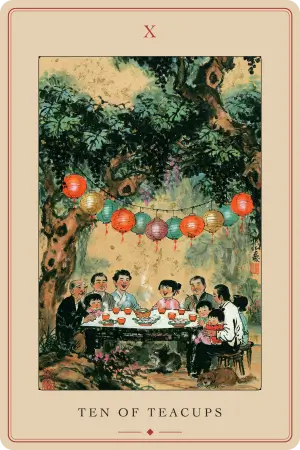


Minor Arcana ·
Apprentice of Teacups
Wonder stops a teahouse boy mid-round: the heart notices something small and alive, and the tray politely waits.
Karta haqida qisqacha
- Numerology
- Apprentice (court rank of Teacups)
- Unsur
- Water
- Astrologiya
- Cancer · Scorpio · Pisces · Earth of Water
- Kabbala yo'li
- Malkuth (Kingdom), throne of the Ace of Cups
- Vaqt
- New feeling · a message slightly delayed
- Ha / Yo'q
- Upright yes · Reversed no
Upright
openness
sensitivity
intuition
new love
emotional message
creative beginnings
wonder
gentleness
Reversed
emotional immaturity
escapism
blocked feeling
moodiness
illusion
withdrawal
forgotten duty
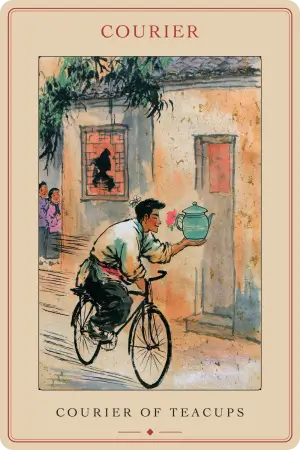
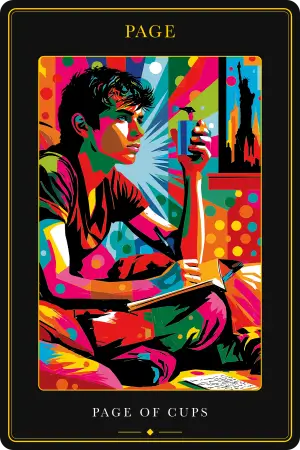
Har bir to'plamda Apprentice of Teacups
Every deck reimagines the same archetype. Compare the art, then open a deck to read its full interpretation.
Imagery and symbolism
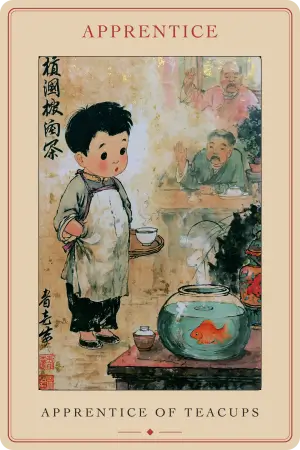
In the Tarot of Beijing the Page of Cups is a teahouse boy who has stopped in the middle of his rounds. A tray with a single steaming cup is still under his arm, forgotten but not dropped, and his nose is pressed to a glass bowl where a goldfish circles in green water on a red-lacquered table. Behind him, drawn in paler ink, two customers wave from their tables, the world of duty calling patiently and a little comically from the background. The card catches the exact moment when wonder outweighs obligation, and neither one destroys the other.
Where the classic Page holds a golden cup with a fish rising from it, here the fish has its own home. The chalice has become a customer's round bowl, a whole miniature sea set down in the middle of a Beijing teahouse, and the fish is the messenger of the subconscious: a sudden insight, a creative idea, the first stirring of love, arriving from another world. Because the boy serves the house, the message will be delivered. It is only, as the deck puts it, slightly delayed.
The steam rising from the cup and the water plant rising beside the bowl curl in the same soft line, feeling and duty drawn with one brush. The apron over his gray robe marks his rank of Apprentice, the beginner's heart, while the vermilion of the fish is the card's one burning accent, a single drop of passion in a scene of muted grays and teals. The gold-flecked kraft paper, the calm Feng Zikai lines, and the small red seal in the corner do here what they do across the whole deck: they show the cosmic through the small and human. Here the cosmos is exactly the size of a fish bowl, and that is enough.
Core meaning
The Apprentice of Teacups is Beijing's Page of Cups, the card that marks the start of an emotional or spiritual journey. As the youngest court rank of the water suit, the Apprentice is the threshold between unformed feeling and lived experience: openness, fresh sensitivity, the beginning of a relationship or an emotional phase. The heart notices something small and alive, and the rest of the world agrees to wait.
Across tarot the Page of Cups is the suit's messenger. Because Cups rule human emotion and the Page rank rules tidings, the card carries news of a tender kind, a letter or a feeling that surfaces from somewhere deeper than thought. Beijing keeps that function and gives it a job. The boy is a servant of the house, so the message is not a vague omen: it is a cup that will reach the right table, once he has finished looking at the fish.
The deck also fixes the archetype's soft, inward direction. This is water, not fire. Where the Apprentice of Wands would draw a picture to publish it, the Apprentice of Teacups draws purely for the pleasure of drawing. His curiosity is childlike rather than conquering, sensitive to beauty and to other people's feelings, and his gift is to be enchanted by what everyone else has stopped seeing. In this deck he is also a promise of what comes later: the boy who stops to marvel is the one who becomes, in time, the Master of Teacups standing calm at the counter.
Upright meaning
Upright, the Apprentice of Teacups asks you to stay open to new emotional experience and to let intuition and curiosity lead. Answers may arrive not as thunder but as a small orange flash in green water, so pay attention to quiet signals and passing wonder. Move forward with an open heart and be patient with your own feelings. The card also carries its own gentle correction: remember, eventually, that there is a tray under your arm and someone is waiting for their tea.
In love. An approaching romantic interest, a first crush, tender feelings, the very beginning of a romance. Love here is the goldfish in the bowl, small and bright and endlessly watchable, not yet asked to prove anything. For settled couples it brings a new source of wonder, learning to look at a familiar person the way the boy looks at the fish. The intentions in play are clear and sincere, and the message is on its way, steaming, on a tray.
In career. New opportunities and happy beginnings: an invitation to a project, an offer of collaboration, or support from someone senior, the master of the house noticing the boy with the tray. It often marks a literal apprenticeship, an internship or a training period, learning a craft from the bottom, cup by cup. Your creativity rises, and the reminder is to love what you do, since even carrying tea can be done with wonder.
In finances. The start of warm-hearted, creative financial ideas, often something the size of a tip on a tray but carrying the seed of more. It favors modest ventures begun with genuine feeling, especially in art, food, tea, hospitality, or care for others. Let intuition flag what makes you stop and look, but keep expectations realistic. He is a boy with a tray, not a merchant with an abacus, so the tea still has to be carried across the room.
In health. Gentle self-care led by curiosity. Approach your own body the way the boy approaches the fish bowl, with attention and delight rather than judgment, and you may find a breakthrough in understanding what you actually need. It supports a fresh routine, a kinder habit, more warmth and more water. Begin small: one cup at a time is exactly how a teahouse serves an entire city.
Reversed meaning
Reversed, the boy is no longer marveling at the fish. He is hiding behind the bowl while the whole teahouse waves for its tea. The card points to emotional immaturity or a misuse of intuition: a rejection of reality, problem avoidance, choices made in a daydream, and a distorted perception that leads to withdrawal. In a yes or no question it usually turns a tentative yes into a no, cautioning that you are lost in idealism and blind to practical complications. The remedy is honest self-analysis, and getting the tea delivered while it is still hot.
In love. Emotional misunderstanding and disappointment, often when an idealized partner fails to match the fantasy and the beloved turns out to be a person rather than a goldfish glowing in green water. One person may carry the full tray while the other only drinks. Broken promises, missing reciprocity, and a reluctance to open up are common. Notice, before it is too late, that someone has been waving at you from across the room for a while.
In career. Frivolity and a habit of starting things without finishing them: fading interest, careless work, cups delivered cold and orders forgotten. Communication with colleagues may snag, and small frictions pile into delayed tasks. Ask honestly whether your current position still holds any goldfish for you, anything that makes you stop and look, then decide whether the work needs changing or only the way you carry the tray.
In finances. Impulsive actions and financial disappointment. An offer that shimmers like a goldfish at first glance can prove far less profitable than promised, pretty in the bowl and worthless at the market. Watch for those who would take advantage of your naivety, and for emotional decisions that quietly drain resources while your attention is elsewhere. Verify the details before you trust anyone's word.
In health. Neglect of the body and a refusal to hear its needs. Emotional overload shows up in appearance and energy, the tray forgotten so long that everything on it has gone cold. Confidence dips, new routines slip, and attention keeps escaping into daydreams. Treat this as a clear signal to come back to yourself and refill your own cup first.
Historical notes
The Page of Cups reached its modern form in the 1909 Rider-Waite-Smith deck, the first to give the Minor Arcana fully illustrated scenes. Arthur Edward Waite and Pamela Colman Smith drew a fair, somewhat effeminate youth on a shoreline, holding a golden cup from which a live fish lifts its head to meet his gaze. Unlike the other Pages, who study a static sword, wand, or pentacle, this one faces a creature that looks back, the fish standing for the subconscious surfacing as sudden inspiration. His blue tunic is scattered with lotus or water-lily blooms, a callback to the Ace of Cups, and his oversized beret and scarf mark an imaginative, bohemian temperament.
Older decks framed the same figure differently. The Tarot de Marseille Valet de Coupes has no sea at all. He wears a crown of flowers rather than a beret and holds an open cup in one hand and its lid in the other, glancing between them, uncertain whether to open or close the vessel. Read psychologically, that hesitation became a guarded heart, someone slow to love again. The Hermetic Order of the Golden Dawn retitled the card the Princess of Cups, or Princess of Water, gave it the elemental dignity Earth of Water, and coded it with female pronouns, granting rulership from zero degrees Libra through thirty degrees Sagittarius.
The Tarot of Beijing keeps the fish and the water and moves the whole scene indoors. The golden chalice becomes a customer's glass bowl on a lacquered teahouse table, and the dreamy youth becomes an ordinary apprentice caught between a circling goldfish and a tray of cooling tea. The sudden inspiration is still there, still arriving from another world, but it lands in a working boy's afternoon rather than on a mythic shore.
Correspondences
Court rank. Apprentice, the deck's Page, the earthly and youngest rank of the Teacups suit. Pages carry no numeral of their own. They are messages and beginnings, the seed rather than the harvest, which is why this one appears at the start of an emotional story rather than its resolution.
Astrology. As a personification of Water, the Apprentice embodies all three water signs at once. Cancer gives the shifting, tender moods and the urge to nurture that make him a server of tea. Scorpio gives the power to be seized completely by one small thing, staring at the fish as if nothing else exists. Pisces gives the subtle intuition and the empathy that reaches past logic, one foot in the teahouse and one in the water. In the Golden Dawn scheme the Princess of Cups rules from zero degrees Libra through thirty degrees Sagittarius.
Element. Water: passive, receptive, inward, concerned with genuine feeling and connection rather than action.
Kabbalah. The Princesses sit in Malkuth, the material Kingdom at the base of the Tree of Life, and the Princess of Cups is described as the throne of the Ace of Cups, the point where emotional energy first becomes something a person can hold.
Elemental dignity. Earth of Water, the earthly manifestation of the suit. Earth grounds and contains what water pours out, like water freezing into ice, so the card is the moment chaotic feeling first takes a shape you can see, as a drawing, a message, or a bowl of clean water on a table.
Psychological perspective
Read as an inner state, the Apprentice of Teacups is the creative inner child, the unjaded part of the psyche that keeps its capacity for wonder. Drawing the card is less a prediction than a mirror: it reflects a longing for emotional release, a need to quiet the inner critic, and an invitation to create purely for the joy of it, the way a child paints without weighing the result. In this deck that is literal. The boy finds absolute value in the simple act of looking, and by keeping the imagination busy with something alive he keeps it from conjuring anxieties instead.
The card also surfaces around emotional regulation and self-compassion. It appears when the inner monologue has grown rigid or punishing and needs softness brought back to it, offering the bowl of clean water as a safe container for feelings that were once shamed or ignored. Before anyone can master emotion the way the Master of Teacups does, they first have to honor it with a child's acceptance. The shadow of the same tenderness is escapism, a preference for the safety of imagination over the friction of real people, which is the reversed card's warning that the tea is going cold while you dream.
Apprentice of Teacups across decks
Rider-Waite-Smith. The canonical Page of Cups stands on a shoreline in a flowered blue tunic, holding a golden chalice from which a fish rises to meet his eye. Beijing keeps the fish and the surprise but gives the fish its own bowl and sets the boy to work, trading the open shore for a teahouse full of waiting customers.
Tarot de Marseille. The Valet de Coupes wears a crown of flowers and holds an open cup and its lid, hesitating between them, a guarded figure slow to open the heart. Beijing exchanges that hesitation for absorption. This boy looks without hesitating; he is only forgetting the tray while he does.
Crowley-Thoth. The Thoth Princess of Cups holds a shell with a tortoise and a dolphin, the Golden Dawn's Earth of Water rendered as playful, dreaming grace. Beijing shares that title and its inward tenderness, and its goldfish plays the part the dolphin plays there, the living creature that carries feeling up from the deep.
Modern reframings. Many recent decks lean into the card's inner-child and messenger readings, drawing the Page as a young artist or a bearer of tender news. The Tarot of Beijing belongs to that movement, locating the whole archetype in one small, human scene: an apprentice, a bowl, and a cup going cold while he marvels.
In combination and context
The Apprentice of Teacups colors a spread with fresh feeling, intuition, and the sense that something new is beginning. In love positions it reads as a budding crush or an incoming heartfelt message, and its neighbors tell you whether the feeling is grounded or a daydream. Beside cards of illusion and fantasy, such as the Seven of Cups, its wonder tips toward wishful thinking, castles built in the bowl that cannot survive open water. Beside cards of vitality and new life it strengthens into a genuine emotional or creative birth.
As the deck's Page, the Apprentice is often a person rather than an event: someone young at heart, curious, emotionally available, the kind boy from the teahouse whom the whole lane knows. In a court progression he is the first step of the water suit, and the Knight, Queen, and Master of Teacups show where his tenderness is headed once it matures. Where the reversed Apprentice sulks behind the bowl, the higher ranks learn to hold feeling steadily and serve it to others at the right moment.
When he keeps appearing, treat him as a nudge to receive whatever is reaching out to you the way a good teahouse receives a guest, with a full cup and no hurry, while keeping one hand on the tray. Stay curious and open, and let the small orange thing circle its bowl for a while, without forgetting that somewhere behind you a cup is waiting to be carried.
Fikr yuritish uchun savollar
- What small, living thing has stopped you mid-errand lately, and what is it trying to tell you before you hurry on?
- Where are you still carrying the tray, the duty you set down while you marveled, and whose tea is going cold?
- When a feeling surfaces, can you give it a bowl of clean water and simply watch it, without needing to solve it right away?
The general meaning follows the Rider-Waite-Smith reading — the reference used across Tarot Academy. Open a specific deck above for its own interpretation.
Frequently asked questions
Tarotni kashf eting
So'nggi maqolalar
Taro kartalarining qadimiy donishmandligini kashf eting va ma'naviy yo'lingizdagi sirlarni oching. Blogimiz taro o'qishning boy ramziyligi, ma'nolari va amaliy qo'llanilishini tushunishga eltuvchi darvozadir.




















































