
 EN (English)


Minor Arcana ·
King of Tokens
Self-made mastery of the material city, held with calm rather than clutched: wealth, provision, and a permanent seat in New York.
Card at a glance
- Numerology
- King
- Element
- Earth
- Astrology
- Taurus · Aries III to Taurus II decans
- Kabbalistic path
- Chokmah (Wisdom)
- Timing
- Late spring, established and enduring
- Yes / No
- Upright yes · Reversed no
Upright
Material mastery
Self-made wealth
Provider
Security
Reliability
Legacy
Generosity
Groundedness
Reversed
Greed
Control through money
Stagnation
Rigidity
Financial recklessness
Status anxiety
Emotionally absent
King of Tokens in each deck
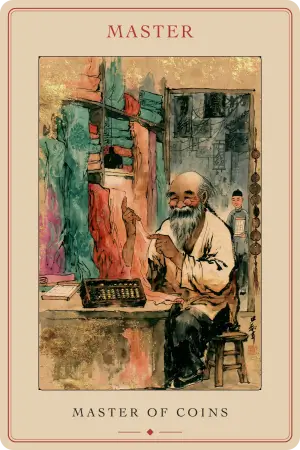
Every deck reimagines the same archetype. Compare the art, then open a deck to read its full interpretation.
Imagery and symbolism
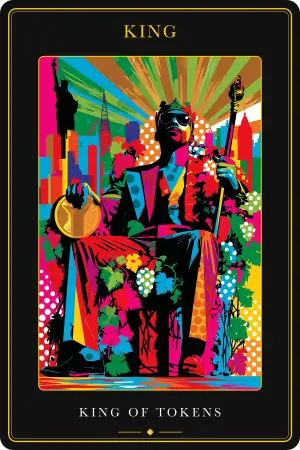
In the Tarot of New York City the King of Tokens sits enthroned in full pop-art blaze: saturated color blocks, halftone dot fields, and hard black silhouette. He is a self-made monarch, crowned and at complete ease on his own ground. He wears a crown and dark sunglasses at once, old authority beside new money, royalty in the New York register where a king's regalia is confidence itself. His face is lifted slightly, unbothered, the look of someone with nothing left to prove.
In one hand he holds a great golden token, the deck's coin of the realm, the brass subway token that once bought passage through the city. His hand rests on it easily, without gripping. That is the card's central statement: the material world mastered and held calmly, not clutched out of fear. In his other hand he holds an upright scepter, an echo of the Rider-Waite King's rod of authority, power exercised deliberately and structure maintained.
Grapevines climb the throne and spill across his lap, clusters rendered in halftone dots. They are the direct inheritance of the Rider-Waite King of Pentacles, whose robe is embroidered with grapes, and they signify abundance that is grown and tended rather than merely acquired, the fruit of long labor enjoyed without apology. Behind him rises the skyline he belongs to, towers in every color, with the Statue of Liberty standing dark at his shoulder like a patron saint of arrival and self-invention. The skyline replaces the RWS castle: his security is not a fortress behind him but the city itself, which he helped build and which now holds him. Sunburst rays fan out from behind his head, a halo of achieved success where the yellow sky of the traditional card becomes pure radiating triumph. The throne is nearly swallowed by vines, flowers, and fruit, so that the King seems to sit directly on abundance, wealth as a living thing that has to be cultivated.
Core meaning
The King of Tokens is the card of arrival in the material city. He built it from nothing, the business, the building, the reputation, and now he holds it without anxiety, the way you hold keys to a door you own. He sits at the top of the suit of Tokens, which this deck renames from Pentacles, the suit of Earth: money, rent, work, and the body. Where the Page learns and the Knight labors, the King owns.
As the completed form of Earth he stands for material mastery that has turned back into life. His wealth is self-made and proven, so his security shows up as generosity: the check covered, the nephew's first month funded, the table kept long. In a reading he signals a period when the practical machinery of your life is working, income steady, foundation real, competence recognized, and decisions finally made from security instead of scarcity. He often points to a concrete person of weight, an owner or provider or self-made figure whose word moves things, or to that same capacity ripening in you.
Upright meaning
Upright, the King of Tokens is the strongest card in its suit: wealth that is real, held, and working. Plans have hardened into assets, skill into reputation, reputation into position. This is the stage where you stop proving yourself daily and start building things meant to outlast you. Operate like someone who has already built something, because you have. Make decisions from experience and the ten-year view, consolidate rather than scatter, and provide generously where you can, since the King's security is proven precisely by how easily he shares it.
In love. He is the partner who shows up steadily, materially, and for good. Love here speaks the city's practical dialects: the lease signed together, the savings merged, the family looked after without being asked. The bond is mature and low-drama because the trust is high, and it often points to a settled, generous partner, usually established and sometimes older, who wants to build rather than browse. This is stoop-and-brownstone love, deep-rooted and meant to hold three generations.
In career. Skills have compounded into mastery and mastery into authority: the title, the corner office, the crew that trusts you, the clients who ask for you by name. The card favors promotion into real leadership, a move into ownership, or the arrival of an old-school, self-made boss who is demanding and fair and worth learning everything from. Financial recognition comes with it, the raise that matches the value, the security that lets you plan in years instead of paychecks.
In finances. Money is mature and self-managing here: the business throwing off steady income, the apartment appreciating while you sleep, the portfolio built patiently through every panic. You know how to price, negotiate, and hold through a bad quarter. The card favors long-term moves, owning over renting and investing over speculating, and it often signals a serious backer or an older self-made figure whose advice outvalues his money.
In health. The body is run like a well-managed building, maintained and inspected on schedule: the morning walk over the bridge, the groceries actually cooked, the sleep defended, the checkups kept. Health here is strong and comfortable, built on unglamorous consistency rather than intensity, and the King invests materially in the body the way he maintains his property, properly and before things break.
Reversed meaning
Reversed, the King of Tokens is the material city turning on its master. The empire is leaking: money mismanaged, the building neglected, the reputation traded on rather than maintained. The productive balance between drive and matter breaks, and the drive gets smothered under sheer accumulation. The card can mark a loss of financial control, a bad investment, a status that was mostly leverage, or a person who has hardened into what New York fears, the landlord who owns you or the boss who counts every dollar and no person. Sometimes it is subtler: you have the money and no life, the terrace and no one on it, the security clenched so tight nothing can grow in your hands.
In love. The material foundation of the relationship becomes its cage. One partner controls the money and, through it, the other: allowance instead of partnership, generosity kept on a ledger and cashed in during arguments. It can show financial dependence quietly eroding freedom, or a partner so consumed by work and accumulation that the relationship gets the leftovers, present in the lease and absent at the table. This is emotional bankruptcy dressed as stability, everything provided except warmth.
In career. The founder becomes the bottleneck, or the professional ground corrodes under him. Watch for rigidity: the iron grip on every decision, the refusal to modernize, the talented people leaving because credit and pay never leave the corner office. In yourself it can look like coasting on seniority, defending turf instead of producing value, or an ego that has outgrown its results. Real effort may also be going unrewarded under a leader who hoards credit and power.
In finances. The fortress is cracking or has become a prison. Look for the classic city failure modes: overpaying for status, hoarding cash so fearfully that stagnation eats it, or trusting a deal because the counterparty looks rich. There may be missed payments, sloppy bookkeeping, or maintenance deferred until it becomes the catastrophe. The instruction is strict: reconcile the accounts, cut the vanity spending, unwind the reckless positions, and stop measuring your worth by what you hold.
In health. The body is treated like a building whose landlord stopped answering. Deferred maintenance is the theme: the checkup postponed for years, the desk-and-delivery lifestyle, comfort eating upgraded by money into a genuinely dangerous menu, the gym paid for and never entered. Every resource goes to work and status while the one non-replaceable asset quietly deteriorates. The correction is the King's own method turned on himself, so schedule the maintenance like rent and start with sleep, walking, and real food.
Historical notes
The King of Tokens descends directly from the King of Pentacles, the court figure who has anchored the suit of Earth since the earliest tarot decks, where the suit was called Coins or Denari. In the Italian and Marseille traditions he was the merchant king, the man of commerce and property. The Hermetic Order of the Golden Dawn later formalized the court cards into a matrix of astrology and Kabbalah, placing every King on Chokmah, the sphere of Wisdom, as the active, outward-driving force of his suit.
The image most readers picture was set in 1909, when Pamela Colman Smith illustrated the Rider-Waite-Smith deck under Arthur Edward Waite. Her King of Pentacles sits on a throne carved with bulls, robed in grapevines, one gold pentacle resting on his knee, a fortified castle behind him. The bulls point to Taurus and the grapes to patiently cultivated wealth, and that grammar of abundance is what the New York deck inherits.
The Tarot of New York City keeps the meaning and re-roots the imagery in the five boroughs. It renames the suit of Pentacles as Tokens, after the brass subway token that once bought passage through the city, so the King of Pentacles becomes the King of Tokens. The bull-carved throne becomes a throne swallowed by halftone vines, the castle becomes the skyline, and the coin becomes the token: the same master of Earth, translated into the currency of New York.
Correspondences
Rank and number. King, the fourth and final court rank of the suit of Tokens, the completed and outward-facing form of Earth. In the older numbering the card carries the values 4, 2, and 14: four for the court's place in the suit, two for the Sephirah Chokmah, fourteen for its sequence after the Queen.
Astrology. In this deck's system the King of Tokens is a Taurus figure, fixed earth fully ripened. He rules the third decan of Aries and the first two decans of Taurus, and his home is the second house of values, money, and possessions, the house of rent, deeds, and accounts that actually clear. Taurean stability runs through him: reliability, patience, and a refusal to be rushed by a city that rushes everyone.
Element. Earth, the suit of Tokens: money, work, the body, and everything physical and lasting. As a King he adds the intellect of Air, strategy applied to matter, the mind of the deal governing the body of the building.
Kabbalah. Chokmah, the second Sephirah, Wisdom: the active, generative spark of the suit brought down into the dense material world.
Elemental dignity. Air of Earth in this deck's court scheme, the strategist of the material plane. He prices things correctly, including himself, and his decisions carry the precision of someone who has read enough bad paper to check every line of the good.
Psychological perspective
Psychologically the King of Tokens is the self-made adult who has made peace with the material world by mastering it. He came up through the suit, the first cleared check, the two jobs juggled, the craft repeated until flawless, and he carries the responsibilities of provider and head of family without complaint or martyrdom. His attractiveness is groundedness, the ease of someone at home in his own frame, whose word closes deals that contracts only formalize.
Beneath the rough manners and unsentimental exterior the essential qualities are loyalty and nobility, dedication to his people and his ground, and a quiet selflessness that speaks through provision rather than words. He is fixed earth emotionally too, slow to anger, hard to move, and formidable once moved.
The shadow is the cost of that same solidity. Fixed earth can ossify into stubbornness and a stiff neck when the neighborhood shifts under him. Push it further and the pursuit of security crowds out everything security was meant to protect, so the person provides for the family financially while staying absent at the table, using wealth as a substitute for warmth. The work of this card is to master the material world without being mastered by it.
The King of Tokens across decks
The New York King of Tokens is one modern reading of a figure every major deck renders in its own idiom. In the Rider-Waite-Smith deck he is the King of Pentacles, seated on a bull-carved throne in grape-embroidered robes with a castle behind him, the established executive of the suit. The Thoth Tarot recasts the rank as the Knight of Disks, mounted rather than seated, the industrious harvest king whom Crowley titled the Lord of the wild and fertile land.
Modern decks push the archetype further. Kim Krans's Wild Unknown renames him the Father of Pentacles, a proud deer with rainbow antlers radiating outward toward practical solutions. Yoshi Yoshitani's Tarot of the Divine casts the rank as Hah-Nu-Nah, the World Turtle who carries the whole earth on its back, the silent and dependable foundation under everyone else. The Light Seer's Tarot shows him relaxed beside the Queen in mutual trust, while the Silicon Dawn turns his shadow into a smooth-talking salesman. Against that lineage the Tarot of New York City makes its own move: it swaps the castle for the skyline and the coin for the subway token, turning the master of Earth into the master of the city that mints self-made fortunes.
In combination and context
The King of Tokens sharpens or sours depending on the company he keeps. Beside the Four of Tokens, the hoarding and withholding card, or cards of isolation, he tilts toward emotional unavailability, the partner too entrenched in money and routine to have bandwidth for vulnerability. Read alongside the Ace or Ten of his own suit, he confirms wealth that is real and building, the long bet paying out. Next to the fast, risk-hungry cards of the suit of Torches he counsels the slower move: the second location after the first one is flawless, not before.
Position matters as much as neighbors. In a money or business spread he is the owner's card, the enterprise crossed from hustle into institution. In love he is the provider who wants to build. As a significator he marks a self-made person of weight in the situation, an owner or backer or elder whose advice outvalues his money. And like his Rider-Waite ancestor he sometimes works as a stalker card, surfacing again and again for a querent who is living in their head or waiting for rescue, with one blunt instruction: get grounded, take honest inventory of your own skills and resources, and become the master of your own domain.
Questions for reflection
- What have you actually built that you rarely give yourself credit for, the skills, habits, and arrangements that quietly keep your life standing?
- Where are you clutching security so tightly that nothing can grow in your hands, and what would it look like to open the fist?
- If you provide for the people around you, are you also present at the table, or has provision slowly become a substitute for it?
The general meaning follows the Rider-Waite-Smith reading — the reference used across Tarot Academy. Open a specific deck above for its own interpretation.
Frequently asked questions
Explore the Tarot
Latest Posts
Discover the ancient wisdom of tarot cards and unlock the mysteries of your spiritual journey. Our blog is your gateway to understanding the rich symbolism, meanings, and practical applications of tarot reading.




















































