
 EN (English)



Minor Arcana · Cups (Water)
Six of Cups
Flower-filled cups shared in a courtyard: nostalgia, innocence, and the return to roots.
Read the complete guide: The Six of Cups Tarot Card: A Complete Guide to its Symbolism and Meaning
Card at a glance
- Numerology
- Six
- Element
- Water
- Astrology
- Sun in Scorpio (2nd decan)
- Kabbalistic path
- Tiphereth (Beauty)
- Timing
- Autumn, the second decan of Scorpio
- Yes / No
- Upright yes · Reversed no
Upright
Nostalgia
Childhood
Innocence
Reunion
Memory
Generosity
Comfort
Inner child
Reversed
Toxic nostalgia
Stuck in the past
Clinging to an ex
Immaturity
Idealizing
Letting go
Peter Pan syndrome
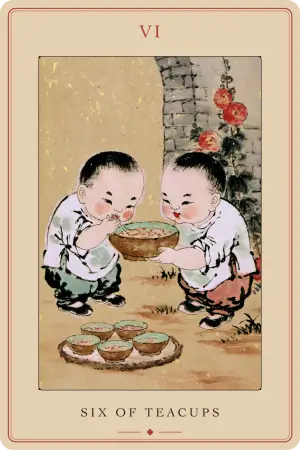
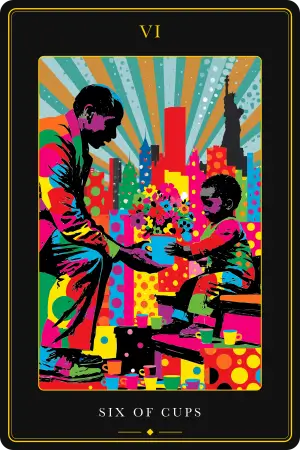
Six of Cups in each deck
Every deck reimagines the same archetype. Compare the art, then open a deck to read its full interpretation.
Imagery and symbolism
In the Rider-Waite-Smith image, the scene is an old cobblestone courtyard backed by the stone walls of a large estate. A taller figure hands a cup to a smaller one, and Waite described them plainly as children playing in a garden. The high walls hold the harsh adult world at bay so that innocence can flourish, an image of a safe space, whether a real childhood home or a remembered one.
Six chalices are filled, uniquely in this suit, with five-petalled white flowers, read as lilies or thornless roses. Filling water cups with flowers grounds emotion in the earth, a sign that feeling has taken root and produced something lasting, and the white marks purity of intention without hidden agenda. Two details sharpen the card. The taller figure's hand is wrapped in a heavy glove or mitten, which Rachel Pollack read as an unequal or restricted dynamic, generosity flowing downward from the one who holds the power. In the background a watchman with a halberd walks away, read variously as a guard keeping the sanctuary safe, adult responsibility receding, or the querent themselves leaving a memory behind.
Core meaning
The Six of Cups is the return to emotional safety after the loss of the Five. Six is the number of harmony restored, and in the Qabalah it belongs to Tiphereth, Beauty, the sun-centred sphere where turbulence is stilled into a moment of emotional perfection. That is why the card feels frozen in time, an idealized snapshot protected from the ordinary forward rush of things.
At its heart the card is nostalgia and the innocence of the inner child. It is the pull back toward roots, the memory of who you were before the world taught cynicism, and the purity of giving a gift simply to see someone smile. Unlike the Six of Pentacles, where charity can be transactional, the Six of Cups is unconditional emotional sharing, warmth offered with no ledger attached.
Upright meaning
Upright, the Six of Cups is tender and warm, built on the sweetness of memory and the comfort of feeling safe. It often means a literal or emotional return to the past: a reunion with old friends, a visit home, or the resurfacing of a hobby or dream that once brought joy. It asks the querent to remember who they were before shame and pressure set in, and to give freely.
In love. A deep, almost karmic familiarity, sometimes the return of an old flame or a childhood sweetheart. It points to a bond built on unconditional care and emotional safety, and it can advise healing a current rift by returning to the love the relationship started with.
In career. A former employer or mentor may reappear with an offer, or the way forward may run through a familiar path or an old passion. Financially it can bring a gift, a small inheritance or the pleasure of giving to others.
In finances. Money that arrives through generosity rather than transaction, a present, a hand from family, or the simple satisfaction of sharing what you have.
In health. A prescription of play, rest and simple pleasures. It suggests the nervous system settles best in safe, nurturing, nostalgic surroundings, and it favours gentle inner-child work over force.
Reversed meaning
Reversed, the past turns from a source of comfort into a prison. The card often shows the romanticizing of an old relationship or era through rose-tinted glasses, a toxic nostalgia that ignores the real incompatibility and quietly broadcasts that the heart is already occupied by a ghost. It can also warn of emotional immaturity, a refusal to grow up and take responsibility, or the resurfacing of childhood and generational wounds that need real attention.
In love. Clinging to an ex who is no longer right, or projecting unmet childhood needs onto a partner. Being stuck in the past blocks new connection.
In career. Stagnation from an unwillingness to adapt, or idealizing a past job and measuring every current option against it unfairly.
In finances. Leaning too heavily on family resources, or a codependent arrangement that keeps the querent from standing on their own.
In health. Old wounds showing up in the body, and often a clear call for therapeutic help to process them. At its more hopeful, the reversal can mark the moment a person finally leaves the courtyard of youth, forgives the past and steps into adult autonomy.
Historical notes
The courtyard scene is a Rider-Waite-Smith creation. Pamela Colman Smith, working under A. E. Waite in 1909, turned a numbered pip into the tableau of the two figures and the flower-filled cups, and Waite's own gloss was simply "children playing in a garden." The layers readers now debate, the gloved hand, the double-faced child, the departing watchman, all sit inside that deceptively sweet image.
Older and later decks frame the number differently. The Tarot de Marseille shows six stylized chalices arranged around central foliage like a formal table setting, an image of conviviality and the steady beauty the number six carries in emotional life. Crowley and Lady Frieda Harris's Thoth deck names the card "Pleasure," lotus cups fed by a calm continuous stream. In the Thoth system that pleasure is hard-won, the deep water of Scorpio standing for the breaking down of the ego and the joy that follows only after the darkest material has been faced and purified.
Correspondences
Number. Six: harmony and restoration after the conflict of the fives. It is the conscious choice to accept help and cross back toward emotional stability.
Astrology. The card is the second decan of Scorpio (about 10 to 19 degrees), under the Sun. The Sun's conscious light cast into Scorpio's hidden depths becomes the mind illuminating buried memory, childhood experience and old karma. The fixed decan holds those moments as snapshots that do not fade.
Element. Water, the element of emotion, memory and the subconscious, here grounded by the earth and flowers in the cups.
Kabbalah. On the Tree of Life the Sixes belong to Tiphereth, Beauty, the sun-sphere at the centre of the Tree, mediating between the higher and lower worlds. Its harmony crystallizes the suit's emotion into a still, radiant moment.
Elemental dignity. A Water card, it rests easily with Earth, which is why its feelings take root, and it warms rather than fights the solar energy it carries.
Psychological perspective
Psychologically, the Six of Cups is the meeting of the adult self and the inner child. Under the Sun in Scorpio it brings the light of awareness into the oldest and most protected rooms of the psyche, which is why it surfaces so often in shadow work and inner-child healing. Its healthy expression is re-parenting, offering your younger self the safety and unconditional love they may have lacked.
The card's shadow is the failure to integrate that past. Memory that is not processed calcifies, and nostalgia becomes a way of living backward. Readers note that the tall figure and the small figure can mirror a childhood wound rather than a healthy adult bond, which is how trauma bonding sometimes disguises itself as a soulmate connection. When the card keeps reappearing, the usual counsel is not to chase an old romance but to address the neurological imprints of early life that are quietly steering the present. Its mandate is to honour the past as a teacher while refusing to let it become a cell.
The Six of Cups across decks
Each tradition lights a different facet of the card. In the Rider-Waite-Smith deck it is the courtyard exchange of flower-filled cups with the watchman in the background, the version this page follows, weighted toward nostalgia, safety and generous giving. In the Tarot de Marseille it is six chalices set symmetrically among foliage, an emblem of conviviality and the steady harmony of the number.
Crowley and Lady Frieda Harris's Thoth deck names it "Pleasure," the balanced high point of the suit reached only after the ego has been broken down and purified. Modern decks stretch it further. The Wild Unknown draws a plain tree above a vast rainbow root system, turning the card toward compassion for the unseen history everyone carries. Indie decks have used it for a trans creator guiding his pre-transition younger self by lantern, or an adult with an aging dog, folding grief and the preciousness of passing time into the same nostalgic frame.
In combination and context
The Six of Cups is best read against its cousin the Six of Pentacles. Both show generosity flowing downhill, but the Cups give unconditionally where the Pentacles keep a ledger, so the Six of Cups is warmth offered for its own sake. In reconciliation readings it is one of the cards most often pulled, and experienced readers treat it with care. It confirms that the past is on the querent's mind and that they crave the comfort of familiarity, but it is not a green light to resurrect a relationship that ended for good reason, and it can flag trauma bonding wearing the mask of destiny.
The card is also a famous "stalker," the one that keeps falling out of the deck. When it does, the usual reading points inward, to a repressed memory or an inner child asking to be re-parented, rather than outward to romance. Position colours it too: as advice it says reconnect with what once brought you joy and give freely; as an outcome it promises a reunion or a return to safe ground, with the quiet caution not to mistake the courtyard walls for a place to live forever.
Questions for reflection
- What version of myself, before the world taught me cynicism, am I being invited to remember?
- Is this memory a source of foundational love, or a rose-tinted story keeping me from the present?
- What would it look like to give my younger self the safety and care they needed back then?
The general meaning follows the Rider-Waite-Smith reading, the reference used across Tarot Academy. Open a specific deck above for its own interpretation.
Frequently asked questions
Explore the Tarot
Latest Posts
Discover the ancient wisdom of tarot cards and unlock the mysteries of your spiritual journey. Our blog is your gateway to understanding the rich symbolism, meanings, and practical applications of tarot reading.




















































