
 EN (English)



Minor Arcana · Pentacles (Earth)
Seven of Pentacles
The pause before the harvest: patience, assessment and the hard wait for effort to pay off.
Read the complete guide: The Tarot Card Seven of Pentacles: A Complete Guide to Its Symbolism and Meaning
Card at a glance
- Numerology
- Seven
- Element
- Earth
- Astrology
- Saturn in Taurus (20°–29°)
- Kabbalistic path
- Netzach (Victory)
- Timing
- Mid-May, or a long wait before the harvest
- Yes / No
- Upright a patient maybe · Reversed no
Upright
Patience
Long-term investment
Assessment
Perseverance
Slow growth
Waiting
Sustainability
Reflection
Reversed
Impatience
Sunk cost
Scattered effort
Frustration
Wasted effort
Stagnation
Poor return
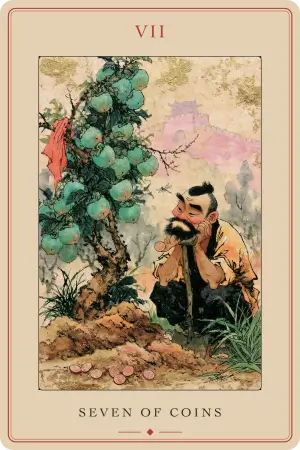
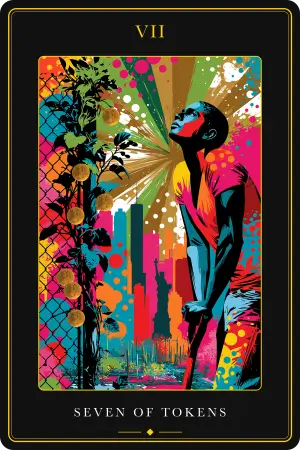
Seven of Pentacles in each deck
Every deck reimagines the same archetype. Compare the art, then open a deck to read its full interpretation.
Imagery and symbolism
In the Rider-Waite-Smith image, a young, weary farmer leans heavily on a wooden hoe and gazes down at a thick vine bearing six golden pentacles. A seventh rests on the ground at his feet. Mountains rise behind him against an evening sky, so the day's labour is done but the harvest has not yet begun. He stands in a lush, thriving garden, and yet he looks tired and distracted rather than triumphant.
The genius of the card is its ambiguity. Is the farmer patiently admiring the fruit of his work, or is he paralysed by exhaustion and the fear that his crop is failing? He is physically disengaged, all his weight on the tool. A subtle detail in the original 1909 printing sharpens the darker reading: several leaves on the vine are browned and withered, suggesting the fruit has grown over-ripe while he hesitated, and that a fatal delay in picking it could spoil the whole harvest. The single pentacle at his feet reads to many as a fallen fruit, a tangible loss from failing to act in time. Time, ruled here by Saturn, does not stop while the farmer daydreams.
Core meaning
The Seven of Pentacles is the card of the pause between labour and reward. It captures the agonising interlude after the seeds are sown and the work is done, but before the harvest is ready. In that suspension a person confronts their impatience, their expectations, and the hard limits of their control over the natural world.
At its heart the card is a test of endurance. The number seven questions material attachments, and here the desire for victory crashes into the dense, slow reality of the physical world. A farmer can pour passion, feeling and knowledge into a field, but cannot force a seed to sprout faster than its own timing. That is the card's humbling lesson: human will is not always enough to force a material outcome. Its whole difficulty, and its peace, lie in whether the querent can surrender to the timeline of the earth rather than fight it.
Upright meaning
Upright, the Seven of Pentacles calls for a shift from daily execution to macro-level evaluation. It marks a committed, long-term effort where the payoff is real but not yet here, and it asks the querent to take stock, prune what is not working, and then trust the slow build. Its temptation is to harvest early out of anxiety, which only truncates the yield.
In love. A slow-built relationship that needs honest assessment rather than fiery pressure, both partners weighing what their years together have grown. For a single querent it counsels patience, since a watched pot never boils. It can also mark deep ambivalence, and at times a "tactical departure," where a partner has quietly decided the emotional harvest is not worth the cost.
In career. A deep commitment to long-term work: a multi-year course, a lengthy apprenticeship, a business built from the ground up. For established professionals it favours drafting five- to ten-year plans and staying with compounding effort over quick wins.
In finances. The pension plan, the long real-estate hold, the power of compound interest. It advises reviewing the portfolio, cutting underperformers, and leaving growing assets alone rather than cashing out early from fear.
In health. A reminder that the body answers to months of sustained effort, not weeks. Habit beats heroics here, so it urges the querent to stay with a regimen even when the scale moves painfully slowly.
Reversed meaning
Reversed, the card warns about misallocated energy and the refusal to reassess honestly. Effort has scattered across too many fronts with little to show for it, or the querent is trapped by what they have already sunk into a losing venture.
In love. A one-way relationship where the querent pours in all the effort while the other reaps the benefit, often bread-crumbed into staying. The sunk cost fallacy bites hardest here, the feeling of being unable to start over after wasting years, watering soil that will not yield. With darker cards nearby it can mark a toxic, manipulative trap the querent refuses to leave.
In career. The sunk cost fallacy in full: staying in a stagnant role, toxic company or failing project purely because of the years already invested, chasing a payoff that is always "next year." It demands a ruthless audit of whether this is patience or terminal paralysis.
In finances. Frustration at meagre returns on heavy effort, or throwing good money after bad to justify past spending. It counsels cutting losses rather than propping up a failing investment out of pride.
In health. Impatience with slow progress that tempts the querent to abandon a working regimen too soon, or mistaking self-defeating thoughts for realism and quitting before real effort has been given.
Historical notes
Older esoteric traditions cast the Seven of Pentacles far more darkly than modern cartomancy does. The Golden Dawn titled it the Lord of Success Unfulfilled, and Crowley's Thoth deck named it bluntly "Failure." That pessimism comes from geomancy: the seven coins are arranged as the figure Rubeus, Latin for "red," an omen of ill fortune so dire that traditional geomancers would abandon a reading in which it appeared as the ascendant. Crowley used its oppressive shape to show matter reaching its most stagnant point before ruin.
Waite and Pamela Colman Smith kept a loose tie to that framework in the 1909 Rider-Waite-Smith deck but added a defining ambiguity, the weary farmer who could be resting or failing, complete with the withered leaves that hint at over-ripe decay. As tarot moved from fortune-telling toward psychology, modern decks rescued the farmer from the brink. The Light Seer's Tarot reveals the invisible root system growing beneath apparent stagnation; the Modern Witch Tarot reframes the pause as necessary, intentional rest against burnout culture.
Correspondences
Number. Seven: evaluation, inner conflict and the questioning of material attachments. Across the suits the sevens all struggle; here the struggle is over assessment and whether the effort spent will be recouped.
Astrology. The card rules the third and final decan of Taurus, from 20° to 29°, roughly 11 to 20 May, governed by Saturn. Restrictive, time-bound Saturn inside slow, fixed Taurus produces grinding inertia and anxiety, the diligent gardener frozen by fear of a wrong move, which is the source of the card's Saturnian dread.
Element. Earth, the element of the body, money and the material world, heavy and bound by the laws of time.
Kabbalah. As a Seven it belongs to Netzach, Victory and endurance, a sphere of high creative energy. In the suit of Earth this is Netzach in Assiah, the desire for victory tested against a physical world that refuses to yield on demand.
Elemental dignity. Its Earth is at its slowest and most patient here; the Saturnian weight asks for humility and the acceptance that the outcome is partly out of human hands.
Psychological perspective
Psychologically, the Seven of Pentacles is a test of the ego's need for control. Saturn's heavy influence demands humility, the quiet acceptance that a person is not the sole author of the outcome. The anxiety in the card, and the modern dread of the sunk cost fallacy, both come from the ego's refusal to accept that lack of control. When the querent finally surrenders to the timeline of the material world, the card turns from a symbol of stagnation into a calm affirmation of natural growth.
Contemporary readers have taken up that reframe. Online communities reject the old "failure" label and call it, affectionately, the "boring adult" card, the unglamorous reality of maintenance and waiting without the adrenaline of sudden change. The soft-life movement goes further, treating the farmer's pause as permission to rest, valuing recovery as a strategic requirement rather than laziness. The deeper work is distinguishing genuine patience from paralysis dressed up as patience.
The Seven of Pentacles across decks
The foundational decks split sharply on this card. In the Tarot de Marseille the Seven of Coins is a geometric arrangement of seven discs, its layout echoing the geomantic figure Rubeus that the esoteric tradition read so darkly. In the Rider-Waite-Smith deck it is the weary farmer leaning on his hoe over the laden vine, the seventh coin fallen at his feet, the version this page follows and the one whose ambiguity opened the door to gentler modern readings.
In Crowley's Thoth deck it is the Seven of Disks, titled "Failure," the coins pressed into the oppressive Rubeus shape to show matter stalled at its lowest point. Modern decks turn the archetype around. Chris-Anne's Light Seer's Tarot shows a figure sending healing intention to a sprouting plant while its roots spread unseen below, an image of invisible progress; Lisa Sterle's Modern Witch Tarot casts the pause as non-negotiable rest; and Kim Krans's Wild Unknown lines seven pentacles in a rigid diagonal, all about strategic assessment and getting one's ducks in a row.
In combination and context
The Seven of Pentacles follows the exchange of the Six as the point where the querent stops to weigh what the giving and building have actually grown. Beside compounding, long-term cards it reads as patience rewarded; beside darker cards such as The Devil or a reversed King of Swords it turns toxic, a person manipulated into staying, trapped by their refusal to cut their losses and walk away from a barren investment.
Position steers it too. As advice it says take stock, prune, and then leave the growing things alone, resisting the urge to harvest early. As an obstacle it names impatience and the sunk cost trap, the inability to tell necessary waiting from wasted waiting. In a yes-or-no reading it declines a clean answer, landing on "it depends," "yes if you are willing to wait," or "not right now." As an outcome it promises a slow, sustainable yield to those who let the timeline do its work.
Questions for reflection
- What am I waiting on right now, and is my stillness patient trust or anxious paralysis dressed as patience?
- Where might I be caught in the sunk cost trap, watering something purely because of the years I have already poured in?
- If I could not speed up the outcome no matter what I did, what would let me rest instead of hovering over it?
The general meaning follows the Rider-Waite-Smith reading, the reference used across Tarot Academy. Open a specific deck above for its own interpretation.
Frequently asked questions
Explore the Tarot
Latest Posts
Discover the ancient wisdom of tarot cards and unlock the mysteries of your spiritual journey. Our blog is your gateway to understanding the rich symbolism, meanings, and practical applications of tarot reading.




















































