 EN (English)

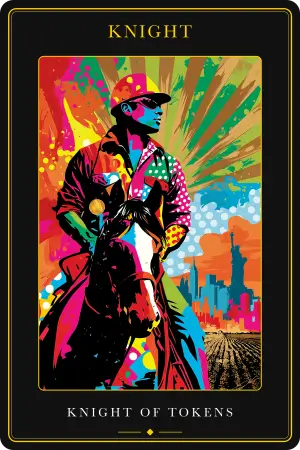


Minor Arcana · Pentacles (Earth)
Knight of Pentacles
The Rider-Waite plough-knight: patient, methodical work that turns plans into lasting material result.
Card at a glance
- Numerology
- Knight
- Element
- Earth
- Astrology
- Late Leo into Virgo · 6th house of work
- Timing
- Slow · long-term, years not weeks
- Yes / No
- Upright yes, in time · Reversed no
Upright
Hard work
Reliability
Patience
Persistence
Responsibility
Methodical
Stability
Loyalty
Reversed
Stagnation
Stubbornness
Rigidity
Perfectionism
Recklessness
Laziness
Unreliability
Boredom
Knight of Pentacles in each deck
Every deck reimagines the same archetype. Compare the art, then open a deck to read its full interpretation.
Imagery and symbolism
In Pamela Colman Smith's 1909 drawing, made under Arthur Edward Waite's direction, a young armoured knight sits on a heavy black draft horse that has come to a complete halt. He holds a single oversized golden pentacle in both hands and gazes into it with unbroken concentration. He is the only Knight in the Rider-Waite-Smith deck whose mount is standing still, and that stillness carries the whole meaning of the card.
The horse is the first clue. It is a muscular workhorse bred to pull a plough through dense soil, not to charge into battle, so its halt reads as a measured, deliberate approach rather than the headlong rush of the other Knights. The dark coat stands for strength and stored energy held in reserve for the goal, and the animal's steadiness mirrors the Knight's own calm. He studies his coin instead of brandishing it, a mind weighing material value and planning the work before it moves.
The palette and the smaller details anchor the rest. His armour is dark and functional, without the theatrical flourishes his fellow Knights wear, while his red gloves and belt mark the decisiveness and drive underneath the caution. The green plumes on his helmet and the horse's bridle are shaped like oak leaves, an image of great oaks grown from small acorns and of slow, compounding growth. Beneath the hooves lies a freshly ploughed field of rich terracotta soil, the prepared ground that waits for seed. Behind it fertile fields stretch to green mountains, standing for the patience and real effort that building material security takes. Earthy browns, dark greens and gold fill the card under a light yellow sky, the touch of clarity a person needs to carry out a detailed material plan. Some readings note a small black book strapped behind the saddle, a ledger or manual the Knight carries to record his progress and study during rest.
Core meaning
The Knight of Pentacles is the deck's steady, hardworking, methodical force, an action figure bound to the element of stillness. That paradox is his character: real drive that pushes forward, but only at the deliberate pace the material world allows. Where the other Knights rush, he prepares, content to labour over long stretches so that success is certain rather than fast.
His work is manifestation, bringing an abstract plan into physical form one brick at a time. Drawing him calls for a disciplined, patient approach and warns plainly against shortcuts. He asks the querent to trust methodical effort even while the results stay invisible. Of all four Knights he holds the firmest grip on his own drive, harnessing ambition to fuel the mundane daily labour without burning out.
Upright meaning
Upright, the Knight of Pentacles is a reliable omen of long-term security won through persistence. He is the unsung hero of industry, the person who handles the steady behind-the-scenes grind that keeps everything running and never asks for the spotlight. His energy suits work that rewards precision and patience: engineering, accounting, surgery, the skilled trades, farming, research.
In love. Feelings that are grounded and slow to surface. This Knight commits carefully, and once he commits he is fiercely loyal. He weighs a partnership in practical terms, long-term compatibility and a shared material foundation, which can read as unromantic but tends to run deep and dependable.
In career. Recognition earned strictly through the quality and consistency of the work rather than office politics or self-promotion. If a promotion is awaited, it is coming, on the strength of reliability.
In finances. Conservative counsel. It favours strict budgeting, long-term planning and trust in compound returns, and it warns firmly against risky bets and get-rich-quick schemes.
In health. Slow, sustainable routines and the patient discipline of showing up. It rewards steady maintenance over dramatic quick fixes.
Reversed meaning
Reversed, the Knight's balance tips one of two ways. With too much earth, his patience hardens into paralysis and stubbornness. Routine curdles into an unfulfilling rut, and he clings to a dead-end job or an unhappy situation because the misery is at least familiar, mistaking stagnation for stability. Perfectionism becomes a shield that keeps a project forever in preparation and never shipped.
With too little earth, he loses his grounding. Impatient with slow processes, he takes reckless shortcuts, makes rushed high-risk decisions and glosses over the details that carry the work. This shadow can also show plain laziness, sloppy craftsmanship and unreliability hidden behind a dependable face. The card's advice is to re-strategise, build genuinely new habits and step out of a comfort zone that has gone stale.
In love. A connection stuck in place, a partner too rigid or too fearful to move, or steadiness that has quietly slid into neglect and possessiveness.
In career. A stalled project trapped in endless planning, or corners cut under pressure that undermine the result.
In finances. Either a rut of fearful inaction or an impulsive, poorly researched gamble that ignores the fine print.
In health. Routines dropped out of boredom, or burnout from grinding monotony with no rest built in.
Historical notes
Waite gave the Knight the keywords utility, serviceableness, responsibility and rectitude, all on the ordinary external plane. Pamela Colman Smith turned those plain virtues into the most static image among the Knights, the workhorse halted in a ploughed field, for the 1909 Rider-Waite-Smith deck.
The Hermetic Order of the Golden Dawn and Crowley's Thoth tradition restructure the court around this same figure. What the RWS deck calls the Knight becomes the Prince of Disks, titled the Lord of the Wild and Fertile Land, riding a chariot instead of a horse and tied to the intellect and organisation of Air. In that system the horse-mounted Kings are reclassified as Knights, and the chariot-riding Princes carry the structural, planning power that designs the physical world rather than only labouring in it. The RWS Knight and the Thoth Prince are the same rank read through two different maps.
Correspondences
Rank and number. Knight, numbered 12 in the court sequence, which reduces to 3, the number of growth and synthesis. Filtered through dense Earth that growth turns physical and slow: the compounding of interest, the brick-by-brick building of a business or an asset.
Astrology. This deck ties the Knight to the transition from the last decan of Leo into the first two decans of Virgo, and places his main sphere in the sixth house of health, work and service to others. Virgo, mutable earth, lends the analytical, systematic, perfectionist streak that makes him attentive to details the other Knights miss.
Element. Earth through the suit of Pentacles, animated in the RWS tradition by the fiery, active rank of the Knight. That makes the card the fiery part of Earth, drive set inside density. The Thoth system reads the same figure as the airy part of Earth, the organising intellect in place of the labouring body.
Elemental dignity. As a dense earth court card he anchors a spread, grounding flighty Air and volatile Fire and pulling airy ideas down into buildable reality.
Psychological perspective
Psychologically, the Knight of Pentacles is endurance turned into a discipline, the drive to see a long project through when the reward is nowhere in sight. His inner tension is genuine: an impatient engine set inside a heavy, slow-moving frame. Managed well, that tension is exactly what lets him dream big and still do the tedious daily labour. Managed badly, the engine either seizes into stubbornness or tears loose into recklessness.
When he keeps reappearing across a querent's readings, practitioners treat him less as a prediction than as a demand from the subconscious to stop skipping steps and make peace with mundane work. The advice is to befriend the Knight, to borrow his persistence and accept that holding your ground and enduring the boredom of routine can be its own quiet strength. Once the querent does the unglamorous work, the card tends to stop stalking them.
Knight of Pentacles across decks
Seen from the Rider-Waite-Smith card, the other foundational decks frame the figure differently. The Tarot de Marseille keeps the court knight in its older formal style, meaning read through rank and suit rather than a painted scene. The Rider-Waite-Smith deck gives the halted workhorse in the ploughed field, the version this page follows.
Crowley and Harris's Thoth deck renames him the Prince of Disks and swaps the horse for a chariot loaded with geometric, agricultural and alchemical symbols, an inventive mind bent on organising and improving the material world. He is the architect who does not just plough the field but designs the irrigation that sustains it. Set against the other three Knights he is the slowest and most grounded. Where Swords rush and Wands blaze and Cups dream, the Knight of Pentacles is the anchor that turns their brilliance, passion and idealism into something that actually lasts.
In combination and context
The Knight's dense energy pulls the cards around him down to earth. With The Empress he promises an abundant material or domestic harvest, patient work meeting natural fertility. With The Tower he marks a traumatic shock to a carefully built routine, a foundation forced to rebuild from rubble. With The Lovers he suggests a steady, even mundane bond that can become deeply fulfilling if both people commit to the practical realities of partnership rather than the first rush of romance. Beside the Five of Pentacles he reads as a long, entrenched silence that offers no warmth or movement for the foreseeable future. Facing the Ten of Cups he can show someone who longs for emotional fulfilment but feels he must lock down perfect material security first. Next to the Two of Swords his careful preparation has curdled into decision paralysis at a crossroads.
Position sharpens him. In a past slot he points to the slow, disciplined groundwork the present rests on. As advice he says commit to the routine and refuse the shortcut. As an outcome he promises results that are slow but solid and lasting. In a yes-or-no reading he is a yes that arrives in its own time upright, and reversed a no that flags either paralysis or a reckless rush past the necessary steps.
Questions for reflection
- Where is patient, unglamorous routine actually the strength this situation needs from me?
- Am I mistaking a comfortable rut for real stability, and what would honest progress look like?
- Which long-term goal am I tempted to shortcut, and what would the slow, proper version cost me?
The general meaning follows the Rider-Waite-Smith reading — the reference used across Tarot Academy. Open a specific deck above for its own interpretation.
Frequently asked questions
Explore the Tarot
Latest Posts
Discover the ancient wisdom of tarot cards and unlock the mysteries of your spiritual journey. Our blog is your gateway to understanding the rich symbolism, meanings, and practical applications of tarot reading.