
 EN (English)


Minor Arcana · Cups (Water)
Nine of Cups
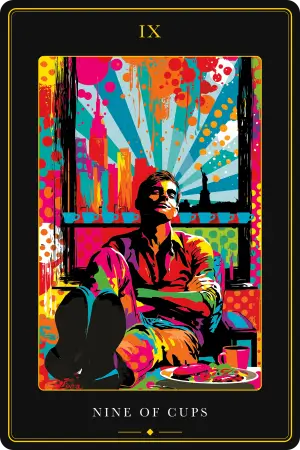
A man reclined in a New York window seat, arms folded and eyes half closed, nine blue coffee cups along the sill while the skyline hands back everything he once asked of it.
Card at a glance
- Numerology
- 9
- Element
- Water
- Astrology
- Jupiter in Pisces (2nd decan)
- Kabbalistic path
- Yesod (Foundation) in Briah
- Timing
- Early March, the second decan of Pisces
- Yes / No
- Upright yes · Reversed no
Upright
Wish fulfilled
Contentment
The city paying you back
Earned satisfaction
Gratitude
Self-sufficiency
Abundance
Emotional well-being
Reversed
Hollow win
Complacency
Smugness curdling
Overindulgence
Performed satisfaction
Borrowed wishes
Ingratitude
Emptiness amid plenty
Nine of Cups in each deck
Every deck reimagines the same archetype. Compare the art, then open a deck to read its full interpretation.
Imagery and symbolism
The New York Tarot renders the Nine of Cups in its house style: halftone dots, sunburst rays, and saturated color set hard against black. At the center a man sits back with his legs stretched out and his arms folded, the classic posture of the Rider-Waite-Smith nine translated from a wooden bench to a city window seat. His eyes are nearly closed, his smile unhurried. The folded arms here read less as defense than as completion. Nothing needs reaching for, because everything he wanted has already arrived.
Along the windowsill behind him runs a row of nine blue cups, the Greek "We Are Happy To Serve You" paper coffee cup that serves as this deck's suit emblem. Where the traditional card arcs its golden cups above the man's head like trophies, here they line the sill like a morning ritual multiplied, nine small daily kindnesses of the city. Their blue is the calm note in a hot palette, feeling held steady inside the celebration.
Through the window the skyline delivers the card's promise. The Empire State Building rises in pink and orange on one side; the Statue of Liberty stands in black silhouette on the other. Ambition and welcome, the two things the man once asked of the city, are now simply the view from his seat. Behind them sunburst rays fan across the sky in blue and white, this deck's recurring signature for a moment of triumph, while confetti-like dots in red, orange, and pink drift across everything and turn the whole sky into a private ticker-tape parade.
In the foreground the wish is made edible. A plate of food and a full mug sit at his feet, so contentment in this deck is not abstract. It is the meal you wanted, in the place you fought to stay, paid for by your own work. His shirt and trousers are patched from nearly every color in the palette, red and magenta and green and blue and yellow, as if the whole city's energy has been stitched into one person at rest. The paint drips and splatters around the frame keep the scene from settling. This is a pause at the top of the wheel, not a retirement.
Core meaning
The Nine of Cups is the wish card of the deck, the moment the city pays out. In esoteric terms it is Yesod, the sphere of the Moon and the subconscious, sitting in Briah, the watery World of Creation, so it marks the emotional realm reflecting on itself and crystallizing a wish just before it lands in daily life. In the New York reading that abstraction becomes concrete: the lease signed, the show booked, the person who texted back, the project that finally paid off.
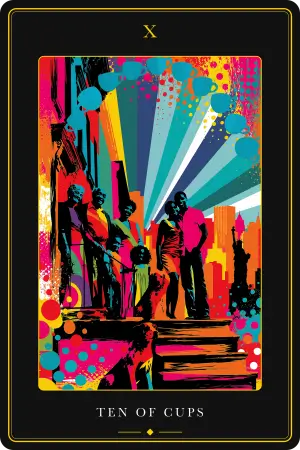
What makes this card distinct from the Ten of Cups is that the happiness is singular. The Ten is the whole family on the stoop; the Nine is still your table, your view, your wish. It is emotional autonomy at its ripest, a satisfaction that does not yet need to be shared to be real. The Golden Dawn called it the Lord of Material Happiness, a title that bridges the fluid world of Cups with the tangible comfort of having enough. At its center is a plain instruction the city rarely gives: stop, look at what you built, and let yourself feel it.
Upright meaning
Upright, the Nine of Cups is the harvest after the grind. A long-held desire actually arrives, and, just as important, you let yourself register it. Emotions are in harmony and satisfaction is at its peak. This is the tarot's permission slip to enjoy the fruits of your labor without the New York guilt that says you should already be earning more. For once, the advice is not to optimize. Sit in it, call the people who carried you, and be grateful out loud before you plan the next move.
In love. Contentment with your person, the relationship equivalent of feet up and rent paid. The bond is developing stably on mutual respect and genuine satisfaction, the standing Friday table, the quiet certainty on the couch after a loud week. It can predict longevity, a deepening of feeling, or a heartfelt wish fulfilled: the move-in, the commitment, the reunion.
In career. The grind paid off. Skills are valued, effort is rewarded, the project landed and the review glowed. A promotion, a completed project, or a role that finally fits, plus the rare contentment of being good at what you do and known for it. Take the long lunch and accept the compliment without deflecting.
In finances. The rent-paid card: prosperity, savings that finally exist, the month where the math works with room to spare. The raise comes through or the check clears, and gratitude is the natural response to earned success. From this comfortable seat you can consider calmly how to grow and protect what you have built.
In health. The body content and cared for, health as one more wish that came true. Enough rest, enough nourishment, enough pleasure in a city that runs most people ragged. Long-pursued physical goals may be about to land. Appreciate what your body has carried you through and enjoy it without apology.
Reversed meaning
Reversed, the Nine of Cups is the corner table that feels hollow. The wish came true and somehow nothing changed inside. It points to unsatisfying results, a victory that did not taste the way it was supposed to, or the city's signature ailment of the moving finish line, where every achievement is instantly reassessed as insufficient. Often the trouble is borrowed desire: New York is very good at handing people someone else's dream and charging full price for it. The card asks you to figure out what you actually wanted, then to practice wanting what is already on the table.
In love. The couple at the best table not talking, everything technically sufficient and happiness somehow elusive. Dissatisfaction here often comes from a partner measured against a highlight reel, or from complacency and taking the person for granted. Drop the perfection standard and either recommit to the real person across the table or admit the wish was never about them.
In career. The promotion that went sideways, the role that looked like the dream and feels like a cubicle. It can expose inflated expectations, wanting the corner office without the intervening decade, or a goal reached with no fulfillment behind it. Reassess honestly: recalibrate and be patient, or start working toward the wish that is actually yours.
In finances. The abundance is thinner than it looks, or real and still unsatisfying. Watch for lifestyle spending that eats the gains, income that lands late or smaller than promised, or losses from celebrating too early. Audit the numbers behind the appearance of plenty, since solvency quietly enjoyed beats abundance anxiously performed.
In health. Dissatisfaction with appearance or well-being that no result seems to cure, usually rooted in unrealistic standards borrowed from filtered images. The opposite failure also shows here: complacency, good habits quietly dropped, indulgence sliding into neglect. The counsel is acceptance plus honest effort and steady care.
Historical notes
Pamela Colman Smith illustrated the Nine of Cups under A.E. Waite's direction in 1909, and that image became the card most people picture. Waite described a goodly personage who has feasted to his heart's content, with abundant refreshment of wine on the arched counter behind him, so the future looks assured. His well-fed figure, his crossed arms, and his nine golden cups displayed like trophies on a blue draped shelf set the template the New York deck restyles.
Before Smith, the older Tarot de Marseille did not illustrate a scene at all. Its Nine of Coupes showed a geometric arrangement of nine vessels, often a three-by-three or floral pattern, and the meaning rested on the numerology of nine: well-being, clarity, and wish fulfillment without any of the psychological reading of smugness that later attached to the merchant. The Hermetic Order of the Golden Dawn gave the card its esoteric scaffolding, naming it the Lord of Material Happiness and describing the decan's image as a grave man pointing to the sky, a gesture that traces all fulfillment back to a higher source.
The New York Tarot keeps the wish-fulfilled core and swaps the props. The arched wine counter becomes a window over the skyline, the golden trophy cups become blue paper coffee cups on a sill, and the wooden bench becomes a city window seat. The result reads the same promise through a wholly local vocabulary.
Correspondences
Number. Nine, the number of completion and the closing of a cycle. In the suit of Cups it is the fullness of feeling reached just before the communal Ten. It is also the number of the Hermit in the Major Arcana, which underlines the card's solitary streak.
Astrology. Jupiter in Pisces, specifically the second decan of the sign, roughly March 1 to 10. Jupiter is the Greater Benefic and the traditional ruler of Pisces, so here it sits in its own domicile and pours expansion, luck, and generosity into a deep and dreamlike water sign.
Element. Water, the realm of emotion and intuition, which in this deck flows through the blue Greek coffee cup, the small everyday vessel of the city's heart.
Kabbalah. Yesod, the ninth Sephirah, the Foundation ruled by the Moon, placed in Briah, the World of Creation assigned to Cups. This is the astral pool where wishes gather before they descend into tangible life.
Elemental dignity. As a strong water card it warms neighboring Cups and Pentacles and can be cooled by airy Swords, which trade felt satisfaction for detached analysis.
Psychological perspective
The Nine of Cups marks a specific developmental moment: the point where a person withdraws their emotional dependencies from the outside world and finds they are enough on their own. This is radical self-love, the necessary precursor to the shared happiness of the Ten. The New York figure with his arms folded is that state made visible, a hard-won stability being guarded against disruption.
The deck leaves the ambiguity intact, which is where the card earns its depth. Read one way, those folded arms are protection of peace, empowering for anyone recovering from a draining dynamic. Read another, they are the smug merchant of the online tarot forums, the person who has everything they need and is closed to giving or receiving any more. The Hermit shares the number and the solitude, but he seeks austere enlightenment while the Nine of Cups enjoys the senses, so the card carries a quiet warning. Autonomy this complete can curdle into isolation if the cups are only ever hoarded and never poured.
The Nine of Cups across decks
In the Tarot de Marseille the card stays abstract, nine cups in a tidy geometric pattern that speaks through number alone: well-being, harmony, a sense of profound peace with none of the merchant's psychology.
Aleister Crowley's Thoth deck titles the card "Happiness" and shows nine cups arranged in symmetry, overflowing with the waters of Briah from lotus blossoms. Because it is Yesod, the Moon, in the suit of Water, Crowley read it as near-perfect emotional equilibrium, though he distrusted stagnation and warned that if the waters stop flowing toward the Ten they turn into a stagnant pool of indolence and vanity. The Golden Dawn's version, the Lord of Material Happiness, keeps a grave man pointing to the sky, so the abundance is always tied back to a divine source.
The New York Tarot inherits the wish-fulfilled meaning from the Rider-Waite-Smith line and rebuilds the picture in pop-art. The nine cups become blue coffee cups on a windowsill, the abundance becomes a plate of food and a full mug at the man's feet, and the divine reward becomes the skyline itself, the Empire State Building and the Statue of Liberty framed as the prize for years of grind.
In combination and context
Surrounding cards sharpen how the Nine of Cups reads. Next to the Empress or the Lovers it leans into pleasure and physical connection, the satisfaction turning sensual and shared. With the Two of Cups it combines personal contentment with a reciprocal bond, so the private wish becomes a partnership.
Other neighbors pull against it. The High Priestess, with her mandate for inward silence, resists the card's outward enjoyment of the senses. The Hermit, its fellow Nine, wants austere solitude rather than material comfort, so together they debate what kind of aloneness this is. The Four of Cups sets the card's open acceptance of joy against apathy and withdrawal, a useful contrast when a reading is testing whether the querent can actually receive what has arrived.
Position matters too. As an outcome card the Nine of Cups is one of the deck's strongest yes answers, though the yes is conditional: you tend to get exactly what you asked for, so the wish had better have been the right one. In a question about reconciliation or communal success, its solitary nature can flip to a quiet no, pointing instead to peace found by walking away and being complete on your own.
Questions for reflection
- Something you once wished for hard has probably become ordinary to you. Which arrival have you stopped celebrating, and how would past-you react to seeing you have it?
- Look at your folded arms. Are you protecting a hard-won peace, or closing yourself off from giving and receiving more?
- Name one thing you are genuinely glad exists in your life, not for the feed and not for anyone else. Just true.
The general meaning follows the Rider-Waite-Smith reading — the reference used across Tarot Academy. Open a specific deck above for its own interpretation.
Frequently asked questions
Explore the Tarot
Latest Posts
Discover the ancient wisdom of tarot cards and unlock the mysteries of your spiritual journey. Our blog is your gateway to understanding the rich symbolism, meanings, and practical applications of tarot reading.




















































