
 EN (English)


Minor Arcana ·
Matron of Coins
Beijing's Queen of Pentacles: a market matriarch whose ledger balances and whose free radish is always given, so the whole lane trusts her scales.
Card at a glance
- Numerology
- Matron
- Element
- Earth (Water of Earth)
- Astrology
- Capricorn · 20° Sagittarius to 20° Capricorn
- Kabbalistic path
- Binah (Understanding) in Assiah
- Timing
- Autumn into winter · harvest stored
- Yes / No
- Upright yes · Reversed no
Upright
material stability
practical care
honest scales
quiet abundance
nourishment
groundedness
shrewd warmth
self-respect
Reversed
hoarding
smothering care
money anxiety
isolation
withheld generosity
neglected body
distrust
stubbornness
Matron of Coins in each deck
Every deck reimagines the same archetype. Compare the art, then open a deck to read its full interpretation.
Imagery and symbolism
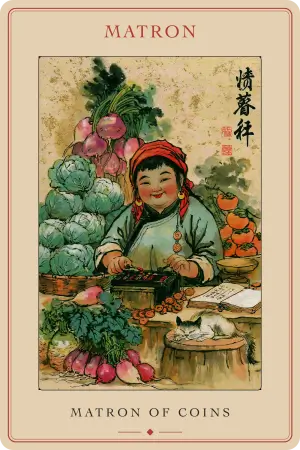
In the Tarot of Beijing the Queen of Pentacles keeps no garden throne. She is the Matron of Coins, a market matriarch seated behind her vegetable stall in a Dashilan hutong, an abacus under one hand and a free radish held out in the other. Where the Rider-Waite-Smith Queen sits enthroned on carved stone, the Matron sits enthroned among her goods: a mountain of cabbages, bundles of pink radishes and purple turnips, a pyramid of persimmons glowing like small lanterns. The harvest is her garden and her throne at once, fertility shown as inventory that has been counted, stacked, and made ready to feed the lane.
Her red headscarf is the suit's vermilion accent, the one warm note in an ink sketch. It carries vitality and standing at the same time: she is nobody's servant, the stall is hers, and the colour says so. Her earrings and the pendant at her breast are strung from square-holed copper coins, the suit emblem worn as ornament. Wealth for the Matron is not locked in the pawnshop chest of the Four of Coins. She wears it lightly, in circulation, close to the heart.
Under her hands lies the abacus, its beads caught mid-calculation. The canonical Queen cradles a single pentacle in contemplation; the Matron works her wealth instead, because counting is a form of care and an accurate ledger is a promise kept to everyone who trades with her. A string of copper cash spills across the counter beside an open ledger book. Nothing is hidden. Her accounts are kept in daylight, in the middle of the market, and that visibility is the whole secret of her authority.
The scale at the table's edge recalls this deck's Justice card, The Hand Scale, and the Matron carries that justice into commerce: her measures are honest, so no one lies at her stall. A cat sleeps curled on the stool beside her, the deck's quiet sign of a household in order, a prosperity certificate issued daily. The warm kraft paper flecked with gold, the few calm brush lines, and the small red seal in the corner keep her inside the deck's Feng Zikai language: nothing cosmic, nothing grand, the whole earth element expressed in one stout, smiling woman who has never confused price with worth.
Core meaning
The Matron of Coins is Beijing's answer to the Queen of Pentacles, the Water of Earth court card of the suit: material well-being, care, and harmony, proven not by a throne in a garden but by a stall the whole hutong trusts. She is well-being earned stall by stall, the keeper of the household and the market at once, holding the abacus in one hand and offering the free radish with the other.
This is success built by hand rather than handed down. She signals steady incoming resources, physical comfort, and dependable stability, and the reputation for fair scales that has itself become a kind of capital. Where the Rider-Waite-Smith Queen contemplates a single coin in her lap, the Matron never stops working hers, and in this deck charity is done with the same scales as trade: given exactly, generously, and without ceremony.
She is also the mature figure of practical wisdom who sees through pretense at a glance and helps without making a show of it. Her care does not ask how you are feeling. It puts something warm in your hands. That is the card's whole argument about what love and provision actually look like when they are real: warmth shown as reliability, prosperity shown as a lane that is fed.
Upright meaning
Upright, the Matron of Coins speaks of confidence, well-being, and care proven daily in practice. This is a period of steady resources, physical comfort, and calm productivity: the stall that opens every morning and closes every evening with the ledger balanced, the slow reward rather than the sudden windfall. She asks you to use your common sense and your skills to get the most from what you already have, because the Matron never wastes a cabbage leaf. Tend your money patiently and without drama, and increase your stability the way a market woman does, transaction by transaction.
In love. A bond proven in deeds, not declarations: the cup refilled exactly when the story gets hard to tell, the coat mended before you noticed the tear, dinner already steaming when you come through the gate. It points to mature, balanced love full of warmth and mutual understanding, two people who know themselves parts of one working household and manage its resources jointly and honestly.
In career. Solid professionalism and effort duly rewarded. Your persimmons have ripened and are being paid for at a fair price. She favours advancement earned through demonstrated competence, expanded responsibility, and the standing of the dependable colleague whose word is as good as a signed ledger. The satisfaction here is grounded: visible results, honest measures, a rhythm you can sustain for years.
In finances. A strong omen of security won through patient effort. She favours steady income and real savings, wise management with neither hoarding nor waste, and investment in tangible, unglamorous assets that yield reliably rather than spectacularly. In this deck a reputation for fair scales is itself wealth, and it compounds.
In health. Well-being of the well-fed, well-rested kind: colour in the cheeks, strength in the arms, an appetite that honours the season. Treat self-care as household management, with regular meals of real food, sleep kept as faithfully as the ledger, and a body treated as the most important asset in the inventory. The Matron's health, like her business, is built from small daily acts repeated at the deliveryman's pace.
Reversed meaning
Reversed, the Matron of Coins points to financial trouble or an unwillingness to carry responsibility. It shows the stall becoming a fortress and the abacus never leaving the hand, or else the household and its people neglected while the takings are counted. The free radish is no longer given, the warm eye has gone cold, and the ledger may still balance while the lane no longer trusts the scales. Take honest stock and make corrections without delay, because an error found early costs a coin and found late it costs the stall.
In love. Materialism and attachment to comfort crowd out genuine connection: the household runs, but nobody is home in it. One partner stands forever behind the counter, weighing and providing and refilling, while the other only consumes. Care can curdle into control, a partner managed like stock to be inventoried. Attend to the emotional ledger with the same honesty you give the financial one, because a cup offered with resentment is neither an offered cup nor an offered heart.
In career. Declining productivity and financial strain, often burnout: the stall-keeper who has not missed a market day in years and has nothing left in the jar of herself. It can mean hard work that receives no recognition or fair reward, heavy baskets and light pay, or haste in pursuit of advancement that produces mistakes a steadier hand would have avoided. Renegotiate your load, and restore the boundary between work hours and rest.
In finances. Poor management of resources, either miserly frugality like the pawnshop owner on his locked chest while the fair goes by outside, or spending that empties the jar faster than the stall can fill it. Watch for lost savings, a sound investment missed out of fear, or clinging to a failing arrangement out of habit. Restore order through honest reckoning and a return to visible scales, because money managed fairly and openly is the only money that stays.
In health. Neglect of your own body while everyone else's cup gets refilled: meals skipped at the counter, rest disregarded, warning signs waved away because there is always another market day to get through first. The reversed Matron is a strict but caring call to put yourself back on the books. The cat sleeps only in a household truly in order, so begin with your own.
Historical notes
The figure behind the Matron is one of the oldest court cards in the deck. In the pre-occult Tarot de Marseille she is the Reyne de Deniers, the Queen of Coins, seated in royal robes and crowned, holding a scepter that resembles a vital ear of corn or a fleur-de-lys, her attention consumed by the large coin she holds aloft. She is the raw administrator of the physical estate: commerce, trade, and the stabilization of material reality, without the psychological and astrological overlays the later occult orders would add.
The modern reading arrived with the 1909 Rider-Waite-Smith deck, illustrated by Pamela Colman Smith. She set the Queen on a massive stone throne carved with fruit, cherubs, and the horned head of a goat, the emblem of Capricorn, signalling that this abundance is the product of time and patience rather than luck. The Queen wears a red gown over a white tunic beneath a green cape that blends her into the garden, and she cradles a single golden pentacle with quiet adoration. A rabbit in the lower corner carries both fertility and the nervous, watchful energy she declines to let govern her.
Aleister Crowley's Thoth deck, painted by Lady Frieda Harris, retitles her the Queen of Disks and strips the garden away entirely. She sits above a solitary palm tree over a vast arid desert, crowned with spiralling goat horns and clad in armour, a colder and more domineering figure who must exert immense will to cultivate life in a barren place. The Tarot of Beijing takes the RWS reframing further in the opposite direction. It removes the stone throne and the single contemplated coin, and reseats the Earth Mother behind a market counter where everyone can watch her weigh. The abundance is no longer admired in the lap; it is stacked on the stall and sold by the catty.
Correspondences
Number. As a Queen she carries no pip number but a rank. In Hermetic Qabalah every Queen of the Tarot is assigned to Binah, the third sphere, whose name means Understanding: the Great Mother, the cosmic vessel, the structuring force that gives form and boundary to raw energy. The Matron is that vessel made literal, a stall and a ledger into which the season's chaos is poured and comes out counted.
Astrology. The Golden Dawn assigns the Queen of Pentacles the sector from 20° Sagittarius to 20° Capricorn, so she rules the third decan of Sagittarius and the first two of Capricorn. Her centre of gravity is cardinal Capricorn: strength, patience, discipline, and an unstoppable climb toward her goals. The Matron simply opens earlier than everyone else and closes later, which amounts to the same mountain.
Element. Water of Earth. The Queens are the water of their suits, and the suit of Coins is earth, so she is water poured into soil: feeling made fertile, care made practical. Water and earth together make mud, the life-giving substance that turned river valleys into the cradles of civilization, and the Matron is that fertile mud given a face and a set of scales.
Kabbalah. Binah operating in Assiah, the lowest and densest of the four worlds, the physical world of human habitation. She is the high concept of form and understanding brought all the way down into commerce, daily toil, and the dirt the cabbages grew in.
Elemental dignity. Strong beside other earth and water cards, which deepen her stability and nurture. Fire and air cards next to her read as the anxiety she keeps in the periphery, the nervous energy she channels toward a deadline without letting it take the counter.
Psychological perspective
The person of this arcana offers a remarkably practical level of care. They do not ask how you are feeling; they put something warm in your hands. Their steadiness makes them a fixed point in their lane, the one everyone's ledger, dispute, and dinner eventually passes through. It is very hard to deceive them, because they weigh people the way they weigh pears, in full view and without apology, and their books always balance, which is exactly why they can share what they have without keeping score.
Water of Earth is feeling made fertile, warmth applied to a task until it sustains someone. At their best they hold work, obligation, and rest in proportion, rooted in season and soil and the small pleasures of the market. The shadow is the martyr. The garden is immaculately tended, the children perfectly dressed, the business thriving, while the body and soul of the gardener are depleted and ignored. Care becomes a defence against intimacy, a household kept flawless so the vulnerable conversation can be permanently deferred, or it hardens into control, affection dispensed with the scales but never freely. The work of this card is to reconnect with the physical body, set fierce boundaries, and learn that self-care is a prerequisite for caring for others, not a selfish afterthought.
The Matron of Coins across decks
Rider-Waite-Smith. The canonical Queen sits on a stone throne carved with a Capricorn goat, cradling one golden pentacle in a lush garden, a rabbit at her feet. The Matron keeps the earth, the patience, and the maternal provision, but trades the garden throne for a market stall and the single contemplated coin for a working abacus.
Tarot de Marseille. The older Reyne de Deniers holds her coin aloft in royal robes, the pure administrator of the physical estate. Beijing keeps that focus on material reality and honest commerce, then moves it out of the palace and into the hutong, where the estate is a vegetable stall and the administration is done in public.
Crowley-Thoth. Crowley's Queen of Disks presides over a barren desert in armour and goat-horned crown, the Earth Mother as harsh, willed survival. The Matron meets that same demanding Capricorn discipline but in its generous key: the mountain is climbed by opening early every day, not by wringing life from a dead land.
Modern reframings. Contemporary decks argue over whether this card is crass materialism or genuine nurture, the woman clutching a designer handbag or the earthy herbalist tending her community. The Tarot of Beijing settles the debate inside one image: the Matron enjoys her persimmons and her warm stove precisely because physical resources are the tools through which she keeps the lane fed.
In combination and context
The Matron of Coins pulls a spread toward stability, resources, and care proven in deeds. Her natural companion is this deck's Justice card, The Hand Scale: together they make honesty into an institution, the fair measure that turns a stall into an authority the whole lane calibrates against. Beside the Ace of Coins she plants the first physical seed of a well-built, sustaining venture, and beside the Seven of Coins her persimmons are the patience of that card ripened at last and paid for.
Her shadow shows in her neighbours. Next to the Four of Coins she risks the fortress, wealth locked in the pawnshop chest instead of worn lightly in circulation. Next to the Ten of Wands she takes on the Lord of Oppression, heavy-handed and overburdened, feeling tasked with bearing the weight of the whole courtyard. In fertility readings she is one of the deck's steadiest indicators, and reversed she rarely denies the possibility; she diagnoses a blocked environment, a body or a home not yet ready, and sends you to repair the vessel first.
When she keeps appearing, treat her not as an outside benefactor but as a call from your own ground: organize your physical environment, stabilize your finances, tend your body, and take sovereign responsibility for your earthly domain. She is fiercely independent and relies on no external provider, and she is asking you to inhabit the abundance already stacked around you rather than the one you wish you had.
Questions for reflection
- What in your material environment is tended well, and what have you quietly left to spoil while attention went elsewhere?
- Where has your care become a form of control, dispensed with the scales rather than given freely like the radish?
- You refill everyone else's cup readily. What would it take to put your own rest, nourishment, and body back on the books?
The general meaning follows the Rider-Waite-Smith reading — the reference used across Tarot Academy. Open a specific deck above for its own interpretation.
Frequently asked questions
Explore the Tarot
Latest Posts
Discover the ancient wisdom of tarot cards and unlock the mysteries of your spiritual journey. Our blog is your gateway to understanding the rich symbolism, meanings, and practical applications of tarot reading.




















































